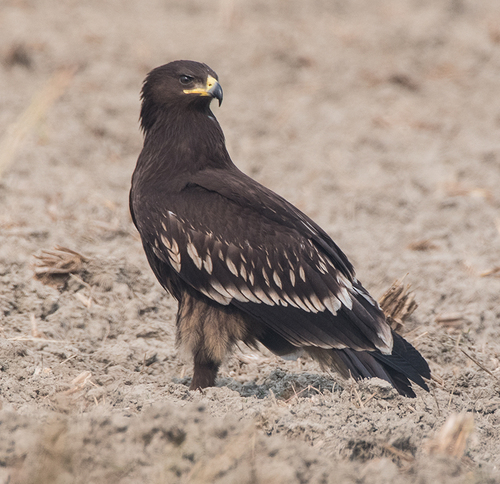
Greater Spotted Eagle
Clanga clanga
The Greater Spotted Eagle is a rare, dark-plumaged wanderer of the world's wetlands. A master of both the sky and the marsh, this vulnerable raptor is a prized sight for any wildlife enthusiast.
Quick Identification
Size
Length: 59–71 cm (23–28 in); Wingspan: 155–180 cm (61–71 in); Weight: 1.5–3.2 kg (3.3–7 lbs)
Colors
Adults are almost entirely dark chocolate-brown; juveniles are blacker with prominent white pearly spots on the wings and a white 'U' on the rump.
Key Features
- Broad wings with seven distinct 'fingers' on the tips
- Uniformly dark brown plumage in adults
- Small, rounded nostrils compared to other eagles
- Heavily feathered legs down to the toes
When You’ll See Them
Geographic range
Where Does the Greater Spotted Eagle Live?
Native to a broad swath of Eurasia, the Greater Spotted Eagle breeds across a corridor stretching from Eastern Europe—including Poland, Belarus, and Russia—all the way to the Russian Far East and northern China. These migratory giants spend their winters in diverse locations across Southern Europe, North Africa, the Middle East, and the Indian Subcontinent, as well as parts of Southeast Asia. While they have a massive range, their populations are increasingly fragmented, making sightings in many regions a rare and special event for birdwatchers.
Basemap © OpenStreetMap contributors
Behavior
The Greater Spotted Eagle is a solitary and somewhat secretive raptor, often found near bodies of water. Unlike some more aggressive eagles, it is known for a patient hunting style, often spending long periods perched on a branch or even standing on the ground waiting for prey to emerge. They are highly migratory, traveling vast distances between their northern breeding grounds and southern wintering wetlands.
In social settings, they are generally quiet but can be vocal near the nest, emitting a high-pitched 'tyuck-tyuck' call. They are notably shy regarding human interaction and are sensitive to disturbances in their nesting habitat, which has contributed to their decline. Interestingly, they are known to occasionally hybridize with the closely related Lesser Spotted Eagle where their ranges overlap.
EverydayEarth exclusive
Camera Tips
Capturing a Greater Spotted Eagle on camera requires a focus on wetland ecology. These birds are rarely backyard visitors unless your property borders a large marsh or wet meadow. To increase your chances, place cameras on high vantage points overlooking water bodies or at the edges of damp forests. A sturdy mount is essential, as these birds may land on the camera housing itself if it's placed on a prominent branch.
Unlike many other raptors that hunt primarily from the air, the Greater Spotted Eagle is known to spend significant time on the ground. Setting up a trail camera near a regular 'walk-and-wait' hunting spot in a wet meadow can provide unique footage of their terrestrial behavior. Use a wide-angle lens if possible and ensure the trigger speed is fast, as they can take flight rapidly if startled.
Because they are active during the peak of the day when the sun is harshest, look for shaded perches that offer high-contrast views of the surrounding clearing. Avoid placing cameras in direct southern exposure to prevent lens flare. During migration seasons (spring and autumn), keep an eye on weather patterns; clear days following a storm often trigger significant movement, making it the best time to ensure your camera batteries are fresh and your SD cards are empty.
Similar Species
Species that look similar or are commonly confused with Greater Spotted Eagle.
Lesser Spotted Eagle
Smaller and typically has paler brown plumage, especially on the head and upper wings.
Steppe Eagle
Features a much deeper gape that reaches behind the eye and lacks the white wing-spotting in juveniles.
White-tailed Eagle
Significantly larger with a massive yellow bill and a distinct white wedge-shaped tail in adults.
Frequently Asked Questions
Record Greater Spotted Eagle at your habitat
Connect a camera to start building your own species record — AI identifies every visitor automatically.