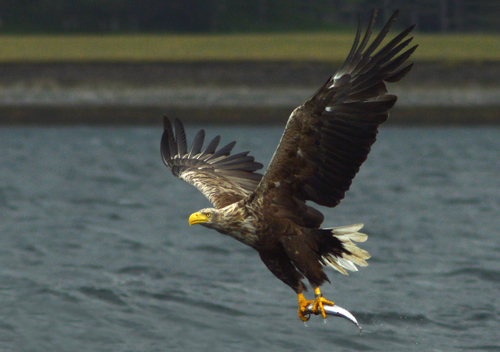
White-tailed Eagle
Haliaeetus albicilla
Meet the 'Sea Eagle' of the North, a massive raptor with a legendary eight-foot wingspan and a striking white tail. From the fjords of Norway to the lakes of Central Europe, this apex predator is a true icon of the wild.
Quick Identification
Size
Length: 66–94 cm (26–37 in); Wingspan: 1.78–2.45 m (5.8–8 ft); Weight: 3.1–6.9 kg (7–15 lbs)
Colors
Adults have a grayish-brown body with a distinctly paler, buff-colored head and neck. They are famous for their pure white, wedge-shaped tail and bright yellow bill and feet. Juveniles are much darker overall with a dark bill and tail.
Key Features
- Massive 'barn-door' wings with deep primary feather finger-slots
- Short, wedge-shaped white tail in adults
- Exceptionally large, thick yellow hooked bill
- Pale yellowish-brown head contrasting with darker body
When You’ll See Them
Geographic range
Where Does the White-tailed Eagle Live?
Native to the vast temperate and arctic regions of Eurasia, the White-tailed Eagle boasts one of the most expansive distributions of any eagle species. Its core range stretches from Greenland and Scandinavia across the Russian wilderness all the way to the Pacific coasts of Japan and China. While they faced significant declines in the 20th century, successful reintroduction programs have seen them return to the United Kingdom, Ireland, and various parts of Central Europe, where they are now thriving near protected wetlands and coastal reserves.
Basemap © OpenStreetMap contributors
Behavior
The White-tailed Eagle is a dominant apex predator, often referred to as the 'King of the Skies' across its Eurasian range. These birds are highly diurnal, spending a significant portion of their day perched on high vantage points such as coastal cliffs or tall trees, scanning the water for prey. Their hunting style is a mix of patient waiting and sudden, powerful bursts of speed to snatch fish from the surface or ambush waterfowl.
While they are solitary or pair-bonded during the nesting season, they can become surprisingly gregarious during the winter. In areas with abundant food, such as salmon runs or carrion sites, dozens of eagles may congregate together. They are known for their massive stick nests, called eyries, which they build in old-growth trees or on cliff ledges and reuse for decades, adding new material each year until the structures reach enormous proportions.
EverydayEarth exclusive
Camera Tips
To capture this 'Flying Barn Door' on camera, you need to think big. Because of their massive 2.4-meter wingspan, close-up shots can often result in a blur of feathers. Position your camera at least 7 to 10 meters away from a suspected perch or feeding site to ensure the entire bird stays within the frame. If you are monitoring a shoreline, aim the camera at an angle that captures both the water's surface and the immediate air above it to catch their dramatic 'snatch-and-grab' fishing maneuvers.
During the winter, White-tailed Eagles are much more likely to descend to the ground to feed on carrion. This provides the best opportunity for trail camera enthusiasts. Set your camera on a short stake or tripod about 2 feet off the ground, facing a natural clearing where they might land. Use a fast trigger speed (0.3 seconds or faster) and high-speed burst mode. These eagles are wary and have incredible eyesight; any 'unnatural' looking equipment should be meticulously camouflaged with local vegetation or burlap to avoid spooking them.
For those living near known nesting or roosting sites, placing a camera high in a neighboring tree can capture incredible social interactions. However, be extremely careful never to disturb a nesting pair; in many countries, it is illegal to approach a nest without a permit. Use a long-range cellular camera so you can monitor the action remotely without having to visit the site and leave a scent trail or cause visual disturbance.
Lighting is crucial for identifying individuals. Try to position your camera so the sun is behind it (facing North in the Northern Hemisphere). This illuminates the eagle's pale head and yellow bill, which are the primary markers used to distinguish mature adults from darker juveniles. Early morning light between 8 AM and 10 AM often provides the most dramatic and clear shots as the birds begin their first hunting forays of the day.
Similar Species
Species that look similar or are commonly confused with White-tailed Eagle.
Golden Eagle
Smaller bill, longer square tail, and prefers mountainous uplands rather than water.
Bald Eagle
The Bald Eagle has a fully white head, while the White-tailed Eagle has a pale brownish-buff head that blends into its body.
Steller's Sea Eagle
Significantly larger with a massive orange bill and prominent white shoulder patches.
Frequently Asked Questions
Record White-tailed Eagle at your habitat
Connect a camera to start building your own species record — AI identifies every visitor automatically.