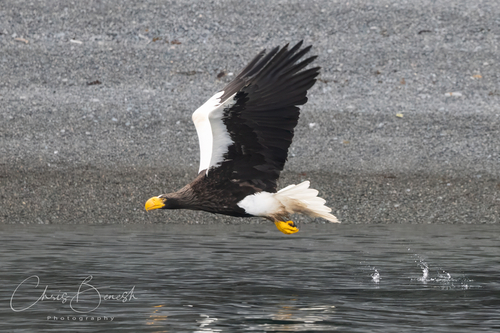
Steller's Sea-Eagle
Haliaeetus pelagicus
With a massive golden beak and a wingspan that commands the northern skies, the Steller's Sea-Eagle is the undisputed heavyweight champion of the avian world. This rare, striking predator is a crown jewel for any wildlife observer lucky enough to find one.
Quick Identification
Size
Length: 85-105 cm (33-41 in); Wingspan: 1.95-2.5 m (6.4-8.2 ft); Weight: 5-10 kg (11-22 lbs)
Colors
Striking dark sooty-brown or black body contrasted by bright white shoulders, thighs, forehead, and a wedge-shaped tail. The massive bill and talons are a vivid, waxy yellow.
Key Features
- Massive, highly arched yellow beak
- Distinctive white 'shoulder' patches (lesser wing coverts)
- Large, white wedge-shaped tail
- Broad, deeply-slotted wings for soaring
When You’ll See Them
Geographic range
Where Does the Steller's Sea-Eagle Live?
Native to the rugged coastlines of Northeast Asia, the Steller's Sea-Eagle is a true master of the North Pacific. Its core breeding range is centered on the Kamchatka Peninsula and the coastal regions around the Sea of Okhotsk in Russia. During the winter, many of these giants migrate south to the Japanese island of Hokkaido and the Kuril Islands to follow the movement of sea ice. While predominantly an Asian species, rare 'vagrant' individuals have famously appeared across North America, appearing in places as distant as Alaska, Texas, and Maine, sparking massive interest from the birding community.
Basemap © OpenStreetMap contributors
Behavior
Steller's Sea-Eagles are powerful diurnal raptors, often spending their mornings perched on high vantage points or ice floes to scan for prey. They are social primarily during the winter months, when hundreds may congregate at prime fishing spots or on sea ice in the Sea of Okhotsk. Despite their size, they are agile hunters, though they are not above 'kleptoparasitism'—bullying smaller eagles or gulls to steal their catch.
Interaction with humans is generally limited due to their remote habitat, though they have become a major draw for ecotourism in Japan and Russia. While they are wary of direct human approach, they can become habituated to the presence of fishing boats, often following them to scavenge for offal or discarded fish. In the breeding season, they are solitary and highly territorial, building enormous stick nests high in trees or on rocky coastal cliffs.
EverydayEarth exclusive
Camera Tips
Capturing the Steller's Sea-Eagle requires planning for cold, coastal environments. If you are in a coastal region where they frequent, place your camera facing a prominent, isolated snag or a high rocky outcrop that overlooks a river mouth or shoreline. These eagles love a 'sentinel' perch with a clear 360-degree view. Because of their immense size, ensure your camera is positioned far enough back to capture the full 8-foot wingspan if they take flight; a wide-angle lens or a distance of at least 20-30 feet is often necessary to avoid 'chopping' the bird in the frame.
Battery life is your biggest challenge in the subarctic temperatures these birds prefer. Use external solar panels if possible, or high-capacity lithium batteries, as standard alkalines will fail quickly in the Russian or Japanese winter. Since the birds are most active in the morning light when the sun is low, position your camera facing North or South to avoid the harsh glare of the rising sun reflecting off the snow or sea ice, which can blow out the white patches on the eagle's plumage.
For triggering, set a high-speed burst mode. These eagles are surprisingly fast when they drop from a perch, and you'll want a sequence of shots to capture the moment their talons hit the water. If using a baited setup (where legal), fresh salmon is the gold standard lure. Mount the camera slightly lower than the bait—roughly 3 to 5 feet off the ground—angled slightly upward to capture the eagle's impressive yellow beak and fierce expression as it lands.
Similar Species
Species that look similar or are commonly confused with Steller's Sea-Eagle.
Frequently Asked Questions
Record Steller's Sea-Eagle at your habitat
Connect a camera to start building your own species record — AI identifies every visitor automatically.