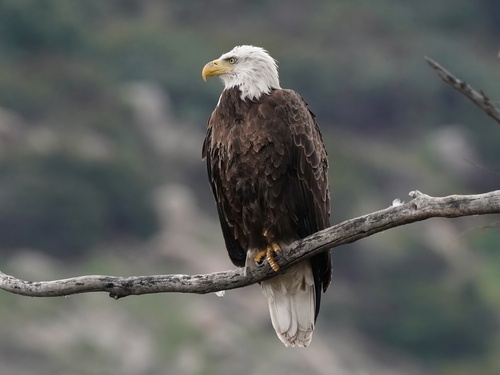
Bald Eagle
Haliaeetus leucocephalus
Witness the majesty of North America's most iconic raptor. From their massive 7-foot wingspans to their piercing golden eyes, Bald Eagles are the ultimate discovery for any backyard wildlife camera.
Quick Identification
Size
Length: 70–102 cm (28–40 in); Wingspan: 1.8–2.3 m (5.9–7.5 ft); Weight: 3–6.3 kg (6.6–13.9 lb)
Colors
Adults have a chocolate-brown body with a snowy white head and tail; juveniles are mottled brown with white streaks under the wings.
Key Features
- Iconic white head and tail (adults)
- Massive, bright yellow hooked beak
- Broad, plank-like wings in flight
- Intense yellow eyes and unfeathered yellow legs
When You’ll See Them
Sightings on EverydayEarth
Apr 13, 2026
A Bald Eagle remains tucked into its nest during a heavy snowfall. The eagle is largely covered in a thick layer of snow, with only its white head and dark wing feathers visible as it periodically turns its head to monitor the surroundings.
Apr 10, 2026
An adult Bald Eagle stands at the edge of the nest, holding a piece of dark prey in its beak. Two small, fuzzy gray eaglets sit in the center of the nest; one is very active, looking up at the parent and chirping loudly while waiting to be fed.
Apr 11, 2026
An adult Bald Eagle is seen tending to its nest in the dark. It carefully uses its beak to probe and adjust the nesting material in the bowl before settling into a resting position.
May 3, 2026
In the pre-dawn darkness, an adult Bald Eagle stands watch over its downy eaglet. The eaglet is active, stretching its neck and looking around the nest bowl while the adult remains standing nearby, occasionally shifting its weight among the nesting materials.
Mar 12, 2026
An adult Bald Eagle is seen sitting in a large stick nest. It is vocalizing frequently with its beak wide open, likely communicating with a mate or defending territory. At approximately one minute and fifty-four seconds into the clip, the eagle stands up to adjust its posture and inspect the nest bowl before settling back down to continue brooding.
Apr 10, 2026
An adult Bald Eagle is seen in its high-altitude nest, carefully tending to a small, grey, downy chick. The eagle uses its beak to gently adjust nesting material and grass around the young bird while looking out over the scenic lake and valley below.
Geographic range
Where Does the Bald Eagle Live?
Native to North America, the Bald Eagle thrives across a vast territory spanning from the arctic regions of Alaska and Canada down through the contiguous United States to northern Mexico. They are most concentrated in areas with abundant aquatic resources, particularly along the Pacific Northwest coast and near the Great Lakes. In recent decades, their range has expanded back into many suburban areas as populations recover and they adapt to human presence.
Basemap © OpenStreetMap contributors
Recorded on EverydayEarth
Behavior
Bald Eagles are diurnal predators known for their impressive aerial displays and powerful flight. They spend much of their time perched prominently in tall trees near water, scanning for prey or watching for opportunities to steal food from other raptors like Ospreys. Despite their fierce appearance, their calls are surprisingly high-pitched whistles and chirps, often described as a 'weak' sound for such a massive bird.
During the breeding season, they are highly territorial, but in winter, they become quite social. Large numbers may gather at communal roosts where food is abundant, such as ice-free rivers or salmon runs. Their nests, or aeries, are architectural marvels constructed of sticks and lined with soft materials; they are among the largest nests in the world, sometimes weighing over a ton after years of renovations.
EverydayEarth exclusive
Camera Tips
To capture high-quality footage of Bald Eagles, placement is everything. Since these birds rarely spend time on the ground unless they are feeding, you should aim your camera at a known 'loafing tree' or a prominent snag overlooking the water. Position the camera at a height of 10 to 15 feet if possible, or use a high-angle mount on a dock or shoreline post. If you have a backyard with tall white pines or cottonwoods near a lake, focus on the highest branches with a clear view of the water.
Baiting for eagles on camera is best done with fresh fish, but be mindful of local wildlife regulations. A better strategy is to place the camera near a natural 'hotspot,' such as a shallow area where fish gather or an ice hole in winter. In suburban environments, eagles are often drawn to tall structures; a camera angled toward a favorite perching branch can provide consistent captures without the need for lures.
For settings, use a fast trigger speed (0.2 seconds or less) to catch the moment they land or take off. Because their white heads can easily 'blow out' in bright sunlight, try to set your camera with a slightly lower exposure compensation. Video mode is particularly rewarding with eagles, as it captures the impressive wing-flapping and vocalizations that a still photo misses.
Seasonality plays a big role in your success. During the winter, eagles are less territorial and more likely to frequent the same spots daily to conserve energy. Look for areas with open water when the rest of the lake is frozen; these spots become magnets for every eagle in the vicinity. During the spring, focus your efforts within a few hundred yards of a nest site to capture 'fly-bys' as the parents bring food to the chicks.
Similar Species
Species that look similar or are commonly confused with Bald Eagle.
Golden Eagle
Golden Eagles are more common in upland/mountain areas and have feathers extending all the way down to their feet, unlike the bare-legged Bald Eagle.
Osprey
Ospreys are smaller with a distinct black 'eyestripe' and fly with a noticeable 'M' shape to their wings, whereas Bald Eagles fly with wings held flat like a plank.
Frequently Asked Questions
Record Bald Eagle at your habitat
Connect a camera to start building your own species record — AI identifies every visitor automatically.