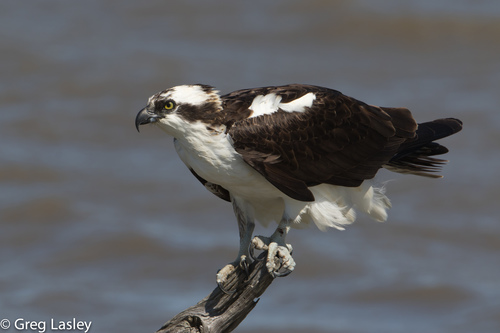
Osprey
Pandion haliaetus
Meet the world's most sophisticated fisherman. With a six-foot wingspan and a specialized 'fish-grip,' the Osprey is a spectacular sight in any waterfront backyard.
Quick Identification
Size
Length: 20-26 in (50-66 cm); Wingspan: 50-71 in (127-180 cm); Weight: 2-4.6 lbs (0.9-2.1 kg)
Colors
Dark chocolate brown on the back and upper wings; snowy white underparts and head. A prominent dark brown stripe runs through the eye to the back of the neck. Females often have a 'necklace' of brown streaks on the breast.
Key Features
- Strongly hooked black beak
- White head with a thick dark eye-mask
- Distinctive 'M' shape to wings when viewed from below in flight
- Large, unfeathered legs with specialized scales and talons for gripping slippery fish
When You’ll See Them
Sightings on EverydayEarth
Mar 31, 2026
An Osprey is perched in its large stick nest overlooking the water. The bird remains relatively still, occasionally turning its head to survey the environment on a bright, sunny day.
Apr 22, 2026
An Osprey is seen incubating a single egg in a large stick nest. It stands up and flies off to the right, followed immediately by another Osprey landing in the nest. After a very brief stay of only a few seconds, the second bird also takes flight, leaving the speckled egg exposed in the center of the nest.
Aug 2, 2026
Under the infrared light of night, an adult Osprey perches vigilantly on a high post above the nest, turning its head to scan the surroundings. Below it, a second bird is hunkered down in the center of the large stick-built nest, resting.
Aug 2, 2026
Three Ospreys are involved in this scene. One sits quietly in the nest while another is perched on a nearby wooden post. A third Osprey flies in and lands on the post, causing the bird already perched there to take flight and depart. The bird in the nest remains settled throughout the interaction.
Aug 2, 2026
In the early morning darkness, an Osprey is perched alertly on a wooden post above the nest, occasionally turning its head and blinking. Below it, another Osprey is seen resting in the center of the large stick nest, occasionally shifting its position.
Aug 2, 2026
An Osprey is perched on a wooden post overlooking the nest, turning its head to scan the surroundings. Inside the nest, a second Osprey, likely a large juvenile based on the scalloped feather edges, remains stationary.
Behavior
The Osprey is a master angler and one of the most widely distributed birds of prey in the world. Unlike most raptors, Ospreys are almost exclusively piscivorous (fish-eating). They are famous for their dramatic hunting style, where they hover over water to spot prey before plunging feet-first from heights of up to 100 feet. They are the only raptor with a reversible outer toe, allowing them to grip fish with two toes forward and two back for a more secure hold while flying.
These birds are highly migratory in most of North America, traveling thousands of miles to Central and South America for the winter. They are incredibly loyal to their nesting sites, often returning to the same platform or snag year after year. While they are generally solitary hunters, they can be quite vocal near the nest, using a series of high-pitched whistles to communicate with their mates or warn off intruders.
EverydayEarth exclusive
Camera Tips
Capturing an Osprey on camera requires a focus on height and water proximity. If you live on a waterfront property, look for tall, dead 'snags' (dead trees) or man-made nesting platforms. These are the most reliable spots for a trail camera. Mount your camera at a slight downward angle if possible, or use a long-range wireless camera if you are monitoring a tall nesting platform. Avoid placing cameras directly on the nest during the early spring to prevent disturbing the birds; instead, set up your gear well before they return from migration.
Because Ospreys are incredibly fast, especially during a dive or takeoff, set your camera to 'Burst Mode' or high-speed video. A trigger speed of 0.2 seconds or faster is ideal to avoid getting a shot of an empty sky where a bird just was. If your camera allows for AI-sensitivity settings, set it to 'Large Birds' to avoid being triggered by small songbirds or moving branches, which will save your battery life and SD card space for the main event.
Lighting is your biggest challenge near water. To avoid 'blowout' (where the white feathers of the Osprey look like a featureless white blob in the sun), try to position your camera with the sun at its back. If you are aiming toward the water, use a lens hood or a DIY shade to prevent glare from the water's surface from triggering the motion sensor or ruining the exposure. Early morning light provides the best contrast for their white heads and dark eye stripes.
While they don't respond to traditional birdseed, you can sometimes 'lure' them into a specific frame by identifying their favorite 'eating perch.' Ospreys almost always carry their catch to a specific high branch to eat in peace. Look for areas with fish scales or droppings (called 'whitewash') on the ground. Placing a camera facing such a branch can result in spectacular, long-duration footage of the bird feeding, which is much easier to capture than a high-speed dive.
Similar Species
Species that look similar or are commonly confused with Osprey.
Bald Eagle
Much larger with a completely white head (no eye stripe) and a massive yellow beak.
Red-tailed Hawk
Lacks the white head and underparts; features a signature reddish-brown tail and different wing shape.
Cooper's Hawk
Significantly smaller with a long, rounded tail and horizontal orange-red barring on the chest.
Frequently Asked Questions
Record Osprey at your habitat
Connect a camera to start building your own species record — AI identifies every visitor automatically.