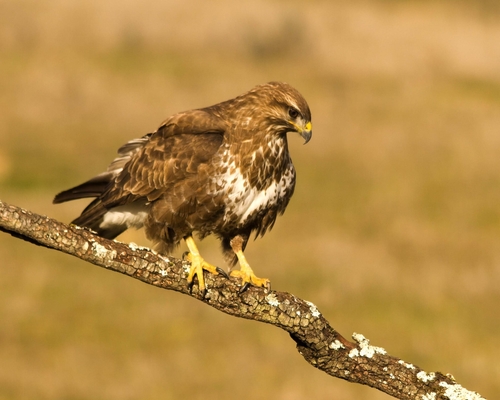
Common Buzzard
Buteo buteo
A master of the skies and a frequent sight over farmland and forests, the Common Buzzard is Europe's most widespread raptor. Known for its soaring flight and iconic cat-like call, it is a fascinating species to observe in the wild or from your own backyard.
Quick Identification
Size
Length: 40–58 cm (16–23 in); Wingspan: 109–136 cm (43–54 in); Weight: 427–1,364 g (0.9–3.0 lbs)
Colors
Extremely variable plumage ranging from dark brown to almost white; typically brown upperparts with paler, streaked underparts and a distinct dark band on the trailing edge of the wings.
Key Features
- Broad, rounded wings and short tail
- Plumage is highly variable (the 'buzzard rule')
- Distinctive 'mewing' call like a cat
- Dark 'commas' at the wrist joints of the underwing
When You’ll See Them
Geographic range
Where Does the Common Buzzard Live?
Native to the vast Palearctic region, the Common Buzzard is a staple of the European landscape, ranging from the British Isles across the continent into Central Asia and northwestern China. While they are permanent residents throughout much of Western and Southern Europe, populations in the colder reaches of Scandinavia and Russia are migratory, traveling to Africa or Southern Asia for the winter. This adaptability has made them one of the most widespread birds of prey in the Old World.
Basemap © OpenStreetMap contributors
Behavior
Common Buzzards are masterful opportunists, often seen soaring in circular patterns on thermals or perched conspicuously on fence posts and telegraph poles. They are 'sit-and-wait' predators, spending long periods scanning the ground for movement. While territorial during the breeding season, they are generally solitary birds, though several may gather where food is abundant, such as freshly ploughed fields or near large carcasses.
Their interaction with humans is usually distant and wary; however, they have successfully adapted to agricultural landscapes and even suburban fringes. They are famous for their vocalizations, often heard before they are seen, emitting a high-pitched, melancholic cry that echoes across the countryside. Despite their size and power, they are frequently harassed or 'mobbed' by smaller birds like crows, gulls, and even lapwings.
EverydayEarth exclusive
Camera Tips
To capture a Common Buzzard on your backyard or trail camera, focus on 'perch-and-wait' locations. These birds love elevated vantage points such as lone fence posts, dead tree snags, or the top of a shed overlooking an open lawn. Mount your camera on a nearby post or tree at roughly the same height as the perch, or angle it upward from the ground if the perch is within 5-10 feet. Because they have keen eyesight, ensure your camera is well-camouflaged and use 'No-Glow' IR settings to avoid startling them if they land at dawn or dusk.
In terms of lures, Common Buzzards are famously fond of earthworms and carrion. After a heavy rain, they may land in the middle of a lawn to hunt worms; placing a camera low to the ground near a wide-open grassy patch can yield great results. If legal in your area, placing a small amount of raw meat or a roadkill carcass in a clear, sunlit spot will almost certainly attract any local buzzards within hours. They are most active during the day, particularly when the sun creates thermals, so set your camera to take bursts of photos or short 20-second videos to catch their landing and takeoff behaviors.
Seasonality plays a big role in their visibility. In the winter, they are much more likely to visit gardens in search of food when natural prey is scarce. During the spring, you might capture them bringing nesting material to nearby trees. Adjust your trigger speed to the fastest possible setting (0.2s - 0.5s) because, while they look slow in the air, their descent onto a perch is surprisingly quick. High-resolution video is recommended to capture the intricate details of their varied plumage, which can help you identify individual birds that frequent your area.
Similar Species
Species that look similar or are commonly confused with Common Buzzard.
Frequently Asked Questions
Record Common Buzzard at your habitat
Connect a camera to start building your own species record — AI identifies every visitor automatically.