Red Kite
Milvus milvus
With its iconic forked tail and effortless soaring flight, the Red Kite is one of the most elegant birds of prey you can spot from your back porch. A true conservation success story, this colorful scavenger has transformed from a rare sight to a beloved backyard regular across much of its range.
Quick Identification
Size
Length: 60–70 cm (24–28 in); Wingspan: 175–195 cm (69–77 in); Weight: 800–1,300 g (1.8–2.9 lbs)
Colors
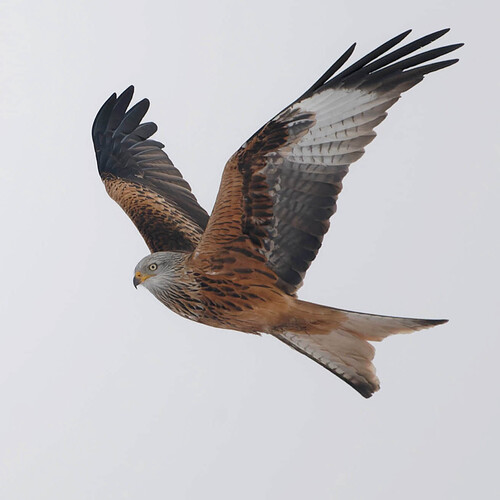
Rusty-red body and tail, pale grey head, black wingtips, and distinct white patches under the wings
Key Features
- Deeply forked 'V-shaped' tail used as a rudder
- Long, angled wings with white primary patches
- Pale, almost white head contrasting with a reddish-brown body
- Graceful, effortless soaring flight pattern
When You’ll See Them
Behavior
Red Kites are the acrobats of the raptor world, known for their incredible agility in the air. Unlike many other birds of prey that rely on high-speed dives, kites are master gliders, using their deeply forked tails to make constant, minute adjustments as they ride thermal currents. They are primarily scavengers, spending hours on the wing patrolling large areas for carrion, though they are also opportunistic hunters of small mammals and invertebrates.
Socially, Red Kites are quite gregarious, especially compared to the more territorial Common Buzzard. It is not unusual to see several kites circling together over a productive foraging site or communal roost. In recent decades, they have become increasingly habituated to humans, moving into suburban areas where they are often seen gliding low over rooftops and gardens in search of food scraps or roadkill.
EverydayEarth exclusive
Camera Tips
Capturing a Red Kite on a backyard or trail camera requires a focus on their aerial habits. Since these birds rarely spend time on the ground unless they are feeding, the best placement for your camera is in a wide-open area with a clear view of the sky or a high, exposed perch. If you have a large garden or field, mount your camera on a fence post or a dedicated 5-foot stake, angling the lens slightly upward (about 10-15 degrees) to catch them as they swoop down to investigate the ground.
Red Kites are highly motivated by food, and in many regions, they have learned to scavenge from human environments. To attract them to your camera's field of view, you can place raw meat scraps (such as chicken wings or beef fat) in a clear, open spot at least 15 feet away from any dense cover. This open placement is vital; kites are cautious and prefer to have a 360-degree view to ensure no predators or competitors like foxes or large dogs are nearby. Early morning light provides the best color rendition for their rusty plumage, so try to position your camera facing north or south to avoid the lens flare of a rising or setting sun.
Because Red Kites are fast and often only stay on the ground for a few seconds to snatch a morsel, camera settings are critical. Set your AI-powered camera to its highest trigger sensitivity and use 'Burst Mode' to take 3-5 photos per trigger. If your camera supports high-frame-rate video, 60fps is ideal for capturing the fluid motion of their tail feathers. During the winter months, when natural food is scarce, they are much more likely to visit garden stations, making this the peak time for high-quality close-up captures.
Similar Species
Species that look similar or are commonly confused with Red Kite.
Frequently Asked Questions
Record Red Kite at your habitat
Connect a camera to start building your own species record — AI identifies every visitor automatically.