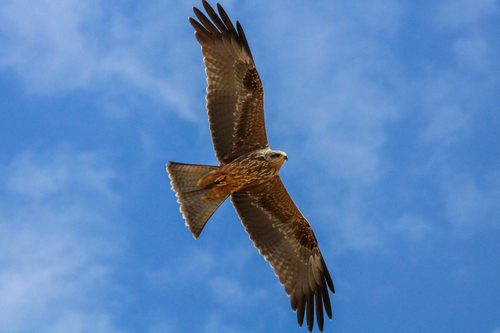
Black Kite
Milvus migrans
The Black Kite is perhaps the world's most successful and abundant bird of prey. A master of the urban sky, this social scavenger is as comfortable soaring over city skyscrapers as it is patrolling the wild grasslands.
Quick Identification
Size
Length: 47–60 cm (18.5–24 in); Wingspan: 130–155 cm (51–61 in); Weight: 630–940 g (1.4–2.1 lbs)
Colors
Uniform dark chocolate-brown plumage; head and neck slightly paler or greyish with dark streaks; yellow cere and legs; dark bill.
Key Features
- Shallowly forked tail, often appearing straight-edged when spread
- Angled 'elbows' in flight with six distinct 'fingers' on wingtips
- Pale patch on the underwing at the base of the primaries
- Medium build with a relatively small head for a raptor
When You’ll See Them
Geographic range
Where Does the Black Kite Live?
The Black Kite is a true citizen of the world, boasting a massive range that spans across much of temperate and tropical Eurasia, Africa, and Australasia. In the northern parts of its range, including Europe and Central Asia, it is a long-distance migrant that travels to Africa or South Asia for the winter. In contrast, populations in tropical regions like India and Australia are often permanent residents, thriving in high-density urban environments where they are a staple of the city skyline.
Basemap © OpenStreetMap contributors
Behavior
Black Kites are among the most social and gregarious birds of prey in the world. They are often seen in large groups, especially when soaring in 'kettles' or roosting together in tall trees. Unlike many shy raptors, Black Kites have adapted remarkably well to human environments, frequently patrolling urban centers, fishing docks, and suburban parks in search of an easy meal. They are master aerialists, capable of performing tight turns and sudden dives to snatch food from the ground or water without ever coming to a full stop.
These birds are famous for their opportunistic scavenging. In some cultures, they are known as 'fire kites' because they are drawn to smoke; they have been observed congregating at the edges of bushfires to pick off small animals fleeing the flames. While they are capable hunters of small mammals and insects, they are equally happy to play the role of a pirate, often harassing other birds to steal their catch in a behavior known as kleptoparasitism.
EverydayEarth exclusive
Camera Tips
To capture the Black Kite on your backyard or trail camera, focus on open spaces with high visibility. Because these birds are primarily scavengers, they are often the first to arrive at a food source. If you have a large property, placing your camera 3–4 feet off the ground facing an open patch of grass or a flat rock can work well. If you live in a suburban area, a camera mounted on a fence post or a flat roof looking down into the yard can capture their dramatic landing and take-off sequences.
Luring Black Kites is relatively straightforward compared to other raptors. They are attracted to raw meat scraps or fish. If you choose to use bait for a photo session, ensure it is secured so they can't simply fly away with it instantly, forcing them to stay within the camera's frame to feed. They have incredible eyesight, so they will spot a potential meal from hundreds of feet up; positioning your camera to catch the 'swoop' is the ultimate goal for any backyard enthusiast.
Regarding camera settings, speed is your best friend. Black Kites are fast and their movements while feeding are often jerky and unpredictable. Set your camera to 'Burst Mode' to take 3–5 photos per trigger, or use high-definition video at 60fps to capture the fluid motion of their wings. Avoid using low-trigger-speed cameras, as you’ll likely end up with nothing but a blur of brown feathers or a tail disappearing from the frame.
Keep an eye out for 'perch-hunting' behavior. If you see a kite frequently sitting on a specific chimney, tall tree, or telephone pole near your home, that is the ideal spot to aim a long-range camera. They often return to the same vantage point to scan the neighborhood. Early morning light provides the best detail for their dark plumage, which can otherwise look like a silhouette during the harsh midday sun.
Similar Species
Species that look similar or are commonly confused with Black Kite.
Red Kite
Much deeper fork in the tail and bright rufous-red plumage compared to the Black Kite's dark brown.
Whistling Kite
Found in Australia; has a rounded tail rather than a forked one and a much paler, sandy-brown underwing.
Black-shouldered Kite
Much smaller with striking white and grey plumage and bright red eyes.
Frequently Asked Questions
Record Black Kite at your habitat
Connect a camera to start building your own species record — AI identifies every visitor automatically.