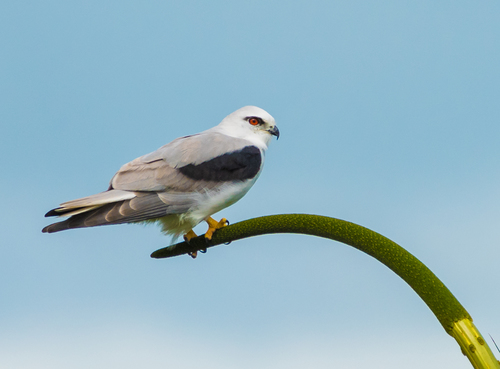
Black-shouldered Kite
Elanus axillaris
Meet Australia’s most graceful hoverer. With its snowy white plumage and piercing red gaze, the Black-shouldered Kite is a stunning raptor that has mastered the art of suburban hunting.
Quick Identification
Size
Length: 35 cm (14 in); Wingspan: 80–100 cm (31–39 in); Weight: 180–365 g (6.3–12.9 oz)
Colors
Pale grey upperparts, pure white head and underparts, with distinctive black patches on the 'shoulders' (lesser wing-coverts); adults have striking red eyes.
Key Features
- Prominent black shoulder patches visible both when perched and in flight
- Piercing red eyes (dark brown in juveniles)
- Unique 'wind-hovering' flight pattern while hunting
- Square-cut white tail that often 'wags' when the bird is perched
When You’ll See Them
Geographic range
Where Does the Black-shouldered Kite Live?
The Black-shouldered Kite is native to the Australian continent, where it is found across nearly the entire mainland. While they are most consistently spotted in the fertile agricultural belts and coastal regions of the south and east, they are highly mobile and will follow prey booms deep into the arid interior. They have successfully adapted to human-altered landscapes, making them a common sight in suburban parklands and along grassy roadside verges in every Australian state.
Basemap © OpenStreetMap contributors
Behavior
The Black-shouldered Kite is a master of the air, most famous for its 'wind-hovering' technique. It can remain almost perfectly stationary in mid-air, with its head fixed on a single point on the ground while its wings flutter and its tail fans out to catch the breeze. This allows it to scan for mice with incredible precision before dropping silently onto its target.
Generally observed alone or in pairs, these kites are quite social during times of plenty, sometimes forming loose communal roosts of up to 50 birds if a mouse plague occurs. They are highly nomadic, moving across the continent to find areas where prey is abundant. Despite being a raptor, they are relatively tolerant of humans and are frequently seen in suburban environments, often using man-made structures like power lines as vantage points.
EverydayEarth exclusive
Camera Tips
To capture the Black-shouldered Kite on a trail camera, focus on 'perch-cam' setups rather than ground-level placement. These birds spend significant time on high, exposed vantage points. If you have a dead tree, a tall fence post, or even a specialized raptor perch in an open area of your property, mount your camera at least 5-6 feet high, angled upward to capture the bird as it lands or scans the ground. Ensure the camera faces away from the direct morning or evening sun to avoid silhouetting their white plumage.
Because these kites are attracted to high-activity prey areas, placing a camera near a known 'mouse run' in a grassy field can capture their dramatic hunting strikes. Set your camera to a high-speed 'Burst' or 'Photo + Video' mode; the strike happens in seconds, and you’ll want multiple frames to catch the moment their talons hit the ground. A fast trigger speed (0.2s or less) is essential for birds of prey.
While you shouldn't use traditional bait, you can 'lure' them indirectly by keeping a portion of your grass slightly longer or maintaining a brush pile, which encourages the local mouse population. If the kites see movement in the grass, they will frequent the area. High-quality AI cameras should be set to recognize 'Birds' specifically to avoid hundreds of clips of blowing grass, which is common in the kite's preferred open habitats.
During the breeding season, watch for pair-bonding behaviors. If you notice a pair frequenting a specific tree, set your camera to monitor nearby branches. They often share food or engage in 'sky-dancing' displays nearby. Just be sure to maintain a respectful distance with your equipment to avoid disturbing their nesting sites.
Similar Species
Species that look similar or are commonly confused with Black-shouldered Kite.
Letter-winged Kite
Look for a prominent black 'M' or 'W' pattern on the underwing during flight; Letter-winged Kites are also primarily nocturnal.
Nankeen Kestrel
Much browner/cinnamon in color compared to the kite's grey and white; kestrels also have a vertical dark 'tear mark' under the eye.
Black-winged Kite
Very similar but found in Africa and Eurasia; the Black-shouldered Kite is the specific Australian representative of this genus.
Frequently Asked Questions
Record Black-shouldered Kite at your habitat
Connect a camera to start building your own species record — AI identifies every visitor automatically.