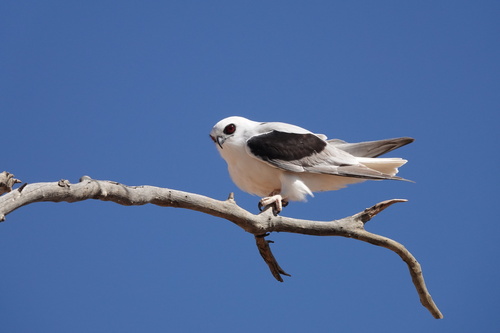
Letter-winged Kite
Elanus scriptus
Meet the ghost of the Australian outback, the world's only nocturnal kite. With its striking red eyes and iconic 'M' wing markings, the Letter-winged Kite is a master of the desert night.
Quick Identification
Size
Length: 33–37 cm (13–15 in); Wingspan: 84–100 cm (33–39 in); Weight: 200–320 g (7–11 oz)
Colors
Pale grey upperparts and pure white underparts, with bold black 'shoulder' patches and a distinctive black 'M' or 'W' pattern visible on the underwing in flight; striking deep red eyes.
Key Features
- Distinctive black 'M' or 'W' pattern on the underside of wings
- Bold black rings surrounding large, deep red eyes
- Stocky, owl-like appearance when perched at night
- Pure white face and underparts contrasting with pale grey wings
When You’ll See Them
Geographic range
Where Does the Letter-winged Kite Live?
Native exclusively to the Australian continent, the Letter-winged Kite calls the arid interior its home, with its core population centered in the Channel Country and the Simpson Desert. During rare irruption events following high rainfall, they migrate nomadically across the mainland, occasionally reaching the coastal fringes of Western Australia, South Australia, and Victoria. They are most commonly found in low-lying basins and floodplains where their rodent prey is most abundant.
Basemap © OpenStreetMap contributors
Behavior
The Letter-winged Kite is a unique anomaly in the raptor world, being the only member of the order Accipitriformes (which includes eagles and hawks) that is primarily nocturnal. While its relatives hunt under the sun, this kite emerges at dusk to patrol the arid grasslands of the Australian interior. During the day, they are highly social, roosting in communal groups within the dense foliage of trees like the Coolibah or Beefwood, often appearing sleepy and lethargic until the sun sets.
Their life cycle is famously irruptive, meaning their population numbers fluctuate wildly based on environmental conditions. When heavy rains trigger a 'plague' of Long-haired Rats, the kites breed rapidly, and their numbers swell. However, when the rodent populations inevitably crash during droughts, the kites disperse across the continent in a desperate search for food, sometimes appearing in coastal suburbs thousands of kilometers from their desert home.
EverydayEarth exclusive
Camera Tips
To capture a Letter-winged Kite on a trail camera, you must think like a nocturnal hunter. These birds are rarely active during the day, so focus your efforts on nighttime monitoring. Place your camera near isolated stands of trees in open plains, particularly species like Coolibahs or Acacias, which they use as daytime communal roosts. Look for 'whitewash' (bird droppings) and pellets on the ground to identify active roosting sites.
Mount your camera at a height of 2 to 3 meters, angled slightly downward toward a likely hunting perch, such as a dead branch or a fence post overlooking an open clearing. Because they are nocturnal, a camera with high-quality No-Glow infrared flash is essential to avoid startling the bird, although kites are generally less flighty at night than many mammals. Use a high-sensitivity sensor setting to ensure the camera triggers the moment the bird lands.
Since these kites follow food sources, the best 'lure' is a high concentration of prey. Setting up your camera near areas where rodents are active—such as the edges of drying waterholes or tall grass patches—will increase your chances. Use a fast shutter speed (if your camera allows) or 'Fast' trigger mode to capture the sharp details of their underwing markings as they swoop, as their flight is incredibly buoyant and quick.
Similar Species
Species that look similar or are commonly confused with Letter-winged Kite.
Frequently Asked Questions
Record Letter-winged Kite at your habitat
Connect a camera to start building your own species record — AI identifies every visitor automatically.