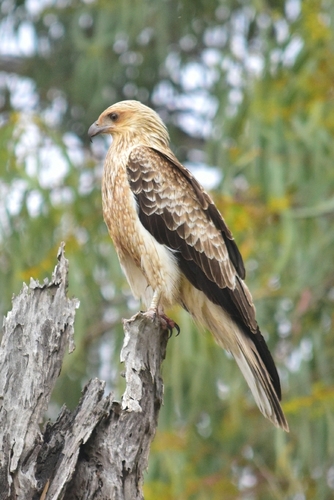
Whistling Kite
Haliastur sphenurus
With its soulful, descending whistle and graceful sandy-colored wings, the Whistling Kite is the quintessential soundtrack to the Australian bush. A master of the air and a clever opportunist, this adaptable raptor is a favorite for backyard observers near waterways.
Quick Identification
Size
Length: 50–60 cm (20–24 in); Wingspan: 120–145 cm (47–57 in); Weight: 600–1,000 g (1.3–2.2 lbs)
Colors
Light sandy-brown head and underparts with pale streaking; dark brown upperparts and wing feathers; pale M-shaped pattern visible on the underwing during flight
Key Features
- Long, rounded tail tip (never forked)
- Distinctive pale 'windows' in the wings forming an M-shape
- Loud, descending whistling call followed by a rapid chatter
- Shaggy, light-colored feathers on the head and neck
When You’ll See Them
Behavior
Whistling Kites are highly social and vocal raptors, often seen soaring in pairs or small family groups. Unlike many other birds of prey that prefer solitary hunting, these kites frequently congregate near food sources like receding wetlands or active farm machinery. They are famous for their namesake call—a long, drawn-out whistle that descends in pitch, often given while they are circling high in the sky to signal their presence to others.
In terms of social dynamics, they are quite bold and can be opportunistic around human activity. They have a relatively slow, lazy-looking flight style compared to falcons, but they are incredibly agile when swooping for prey or competing with other scavengers. While they are territorial during the breeding season, you will often find them sharing thermals with other raptor species without much aggression.
EverydayEarth exclusive
Camera Tips
To capture a Whistling Kite on your backyard camera, focus on 'sky-viewing' placements or high perches. These birds love to survey their territory from the highest available dead branch. If you have a tall tree on your property, try mounting your AI camera on a nearby structure or a high pole angled toward a prominent, bare limb. This is where they are most likely to land to scan for prey or consume a catch.
Because they are opportunistic scavengers, you can successfully draw them closer to the ground using a 'bait station' in an open area. A flat platform or a cleared patch of grass with fresh fish or raw meat scraps (avoiding processed meats) can entice them to land. Position your camera about 5-10 feet away from the bait at a low angle to capture the dramatic moment they drop their talons for a landing. Ensure the camera is set to a high trigger speed, as their descent and take-off are much faster than they appear when soaring.
Lighting is your best friend when filming raptors. Try to position your camera with the sun at its back so that the bird's underwing patterns—specifically that iconic pale 'M' shape—are fully illuminated as they fly over. If you live near water, placing a camera on a tripod at the water's edge can capture them 'dipping' for fish or drinking. During the heat of the afternoon, they are most active in the sky, so setting your camera’s sensitivity to high can help it trigger on birds passing further away in the background.
Similar Species
Species that look similar or are commonly confused with Whistling Kite.
Black Kite
The Black Kite has a distinctively forked tail and darker, more uniform plumage compared to the sandy-colored Whistling Kite.
Little Eagle
The Little Eagle has a shorter, squarer tail and heavily feathered legs, whereas the Whistling Kite has bare lower legs and a rounded tail.
Swamp Harrier
Swamp Harriers have a prominent white rump patch and fly with their wings held in a distinct 'V' shape, unlike the flatter profile of the Whistling Kite.
Frequently Asked Questions
Record Whistling Kite at your habitat
Connect a camera to start building your own species record — AI identifies every visitor automatically.