Little Eagle
Hieraaetus morphnoides
The Little Eagle is Australia's smallest eagle, a compact powerhouse of the skies recognizable by its feathered legs and 'M' shaped wing patterns. A master of the woodland edge, it brings a touch of wild raptor majesty to rural and suburban fringes.
Quick Identification
Size
Length 45-55 cm (18-22 in); Wingspan 100-120 cm (39-47 in); Weight 600-1100 g (1.3-2.4 lbs)
Colors
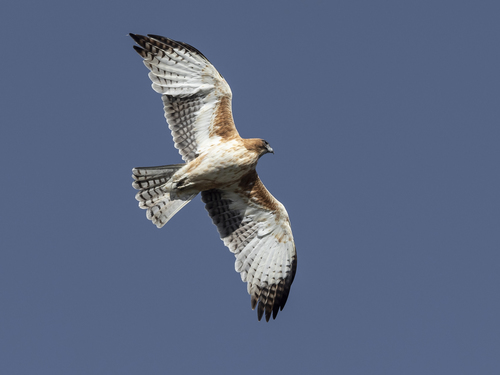
Comes in light and dark morphs; typically brownish above with a pale diagonal bar on the upper wing and a dark 'M' pattern on the buff-colored underwing.
Key Features
- Distinctive dark 'M' pattern on underwing visible in flight
- Feathered legs (tarsus) reaching all the way to the toes
- Small, pointed crest often visible when perched
- Relatively short, square-ended tail compared to other raptors
When You’ll See Them
Geographic range
Where Does the Little Eagle Live?
Native to the Australian continent, the Little Eagle is found across almost the entirety of mainland Australia. While it is a widespread species, it is most common in the open woodlands of the interior and the eastern coastal hinterlands. It is considered a rare visitor to Tasmania and is less frequently seen in the most densely forested parts of the Great Dividing Range and the hyper-arid centers of the western deserts.
Basemap © OpenStreetMap contributors
Behavior
The Little Eagle is a dynamic and active raptor, frequently seen soaring in tight circles high above open woodlands or gliding effortlessly along ridges. Unlike many larger eagles that rely on sit-and-wait tactics, the Little Eagle is a versatile hunter that often uses 'quartering'—flying low and methodically over the terrain to flush out prey. They are highly territorial during the breeding season, often performing spectacular undulating flight displays to warn off intruders.
While they are generally shy and avoid high-traffic human areas, they have adapted well to rural-residential fringes where large, mature trees remain. They are known for their 'eagle-like' silhouette even at a small size, maintaining a regal posture when perched. In the presence of larger raptors like the Wedge-tailed Eagle, the Little Eagle is cautious but will fiercely defend its nesting site from smaller crows and magpies.
EverydayEarth exclusive
Camera Tips
To capture a Little Eagle on a backyard or trail camera, focus on 'vantage points' rather than ground-level movement. If your property has a tall, dead tree (a 'stag') or a high, bare branch overlooking an open area, this is the ideal spot for a camera. Use a sturdy mount to secure the camera at a height of 3-5 meters if possible, aiming it at the branch where the eagle is likely to perch while scouting for prey.
Since these eagles are attracted to water, especially in drier climates, a wide, ground-level birdbath or a livestock trough can be an excellent camera trap location. Place the camera 2-3 meters away from the water source, angled slightly upward. Little Eagles are wary, so ensure the camera is well-camouflaged with natural vegetation and has a fast trigger speed to capture them as they land or depart.
Set your camera to take multi-shot bursts or short video clips (15-30 seconds). The way a Little Eagle ruffles its feathers or scans the horizon is a key diagnostic feature for identification. Avoid placing cameras in deep, dark forest thickets; instead, focus on the 'edge' zones where woodland meets lawn or pasture, as this is their primary hunting corridor. The best light for capturing their intricate wing patterns is mid-morning, once the sun is high enough to illuminate their underside during flight.
Similar Species
Species that look similar or are commonly confused with Little Eagle.
Whistling Kite
The Whistling Kite has a distinctly rounded tail and lacks the feathered legs (tarsus) of the Little Eagle.
Wedge-tailed Eagle
Much larger with a very distinct wedge-shaped tail; the Little Eagle is roughly half the size and has a square tail.
Booted Eagle
A close relative found in Eurasia/Africa; looks almost identical but does not occur naturally in Australia.
Frequently Asked Questions
Record Little Eagle at your habitat
Connect a camera to start building your own species record — AI identifies every visitor automatically.