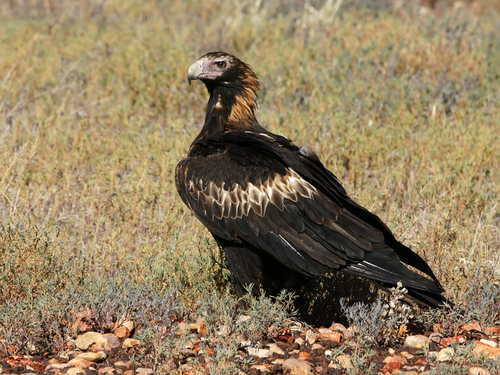
Wedge-tailed Eagle
Aquila audax
Meet Australia’s largest bird of prey, a magnificent raptor with a massive wingspan and an iconic wedge-shaped tail. From soaring high on desert thermals to patrolling rural forests, the Wedge-tailed Eagle is the ultimate master of the sky.
Quick Identification
Size
Length: 81–106 cm (32–42 in); Wingspan: 1.82–2.84 m (6 ft – 9 ft 4 in); Weight: 2–5.8 kg (4.4–12.8 lb)
Colors
Adults are dark brown to almost black with rusty-brown hackles on the neck. Juveniles are lighter brown with buff-colored streaks.
Key Features
- Distinctive wedge-shaped tail visible in flight
- Fully feathered legs all the way to the toes
- Massive wingspan with deeply 'fingered' primary feathers
- Deep-set eyes and a pale, heavy beak
When You’ll See Them
Behavior
The Wedge-tailed Eagle is the undisputed king of the Australian skies, known for its majestic soaring and territorial nature. These eagles are often seen circling at immense heights, using rising thermals to stay aloft for hours while scanning the ground for prey. While they are apex predators, they are also highly social within their pair bonds, often remaining together for life and collectively defending a vast territory that can span several square kilometers.
In terms of human interaction, 'Wedgies' are generally shy and wary of people, preferring to nest in tall trees far from disturbance. However, they are occasionally seen near roadsides scavenging carrion. Their intelligence is remarkable; they have been known to work in pairs to hunt larger prey or even defend their nests against drones or low-flying aircraft, making them a formidable and respected presence in the bush.
EverydayEarth exclusive
Camera Tips
Capturing the Wedge-tailed Eagle on a backyard or trail camera requires a strategic approach, as these birds spend most of their time high in the air. If you live on a rural property or a suburban fringe with large trees, focus your camera on high, open vantage points or 'perch trees' where eagles might land to survey their territory. Aim your camera at a slight upward angle towards prominent dead branches or high-canopy limbs, as these are preferred lookout spots. Setting your camera 10-15 feet high on an adjacent tree can provide a stunning eye-level perspective if you can safely manage the installation.
For ground-based shots, the most effective 'lure' is natural carrion, though this is only recommended in rural settings to avoid attracting unwanted pests to residential homes. Placing a camera near a known rabbit warren or a clear open patch of ground where you've seen them land can also yield great results. Because of their incredible eyesight, ensure your camera is well-camouflaged and uses 'No-Glow' or 'Black' IR LEDs, as the faint red glow from standard night vision can spook them during dawn or dusk transitions. High-speed shutter settings are essential because, while they look slow in the air, their movements during landing or takeoff are incredibly fast.
Timing is everything. Program your camera to be most sensitive during the middle of the day when thermals are strongest, as this is when they are most likely to drop down from the sky. During the breeding season (winter and spring), you might capture rare pair interactions or juveniles learning to hunt. To get the best wing-detail shots, place the camera so it faces away from the sun (north-facing in the Southern Hemisphere) to avoid silhouetting these dark birds against a bright sky. Use a fast trigger speed—ideally under 0.5 seconds—to catch them as they swoop into the frame.
Similar Species
Species that look similar or are commonly confused with Wedge-tailed Eagle.
White-bellied Sea Eagle
Features a white chest and belly with a shorter, rounded tail compared to the eagle's dark body and wedge tail.
Whistling Kite
Much smaller with a rounded tail and a distinct, high-pitched whistling call.
Little Eagle
Displays a square-cut tail and a characteristic pale 'M' pattern across the upper wings when viewed from below.
Frequently Asked Questions
Record Wedge-tailed Eagle at your habitat
Connect a camera to start building your own species record — AI identifies every visitor automatically.