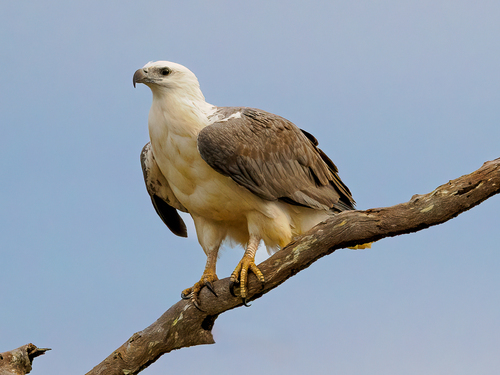
White-bellied Sea-Eagle
Icthyophaga leucogaster
A majestic master of the coastal wind, the White-bellied Sea-Eagle is easily identified by its striking white-and-grey plumage and massive wingspan. Watching one snatch a fish from the water surface is one of nature's most impressive displays of precision and power.
Quick Identification
Size
Length 70–90 cm (28–35 in); Wingspan 1.8–2.2 m (5.9–7.2 ft); Weight 2.5–4.5 kg (5.5–9.9 lb)
Colors
Adults have a snow-white head, neck, and underparts with dark slate-grey upperparts and black flight feathers. Juveniles are mottled brown with cream-colored feather edges.
Key Features
- Distinctive short wedge-shaped white tail
- Broad, upswept wings held in a 'V' shape while soaring
- Contrasting black flight feathers against white under-wing coverts
- Loud, rhythmic goose-like honking call
When You’ll See Them
Behavior
The White-bellied Sea-Eagle is a commanding presence in the coastal skies, known for its effortless soaring and high-altitude territorial displays. They are monogamous and typically form long-term pair bonds, often returning to the same massive stick nest year after year. These nests, located high in sturdy eucalyptus trees or on rocky cliffs, can grow to several meters deep as the birds add new material each season.
While they are formidable hunters, they are also highly opportunistic and are frequently seen scavenging for carrion or engaging in kleptoparasitism—a behavior where they harass other birds like Ospreys or Caspian Terns until they drop their catch. During the breeding season, pairs perform spectacular aerial acrobatics, including 'talon-dropping' where they lock feet in mid-air and tumble toward the earth before releasing.
EverydayEarth exclusive
Camera Tips
To capture high-quality footage of a White-bellied Sea-Eagle, placement is everything. Since these birds rarely descend to the ground except to feed on large carrion, avoid placing cameras at ground level. Instead, aim your camera toward 'sentinel perches'—prominent, often dead, branches of tall trees that overlook the water. If you live on a waterfront property, mounting your camera on a high pole or roofline facing the water will help capture their low-altitude hunting glides. Set your camera to a fast shutter speed or 'Sports Mode' to minimize motion blur from their massive wings.
Exposure management is critical for this species. Their brilliant white underparts reflect intense sunlight, which can lead to 'blown out' images where all detail is lost in a white blob. If your camera software allows, slightly underexpose the image during the middle of the day. For the most dramatic shots, position your camera with the morning sun at its back; this illuminates the eagle's white chest as it scans the water. If you are using a trail camera, ensure the 'PIR' sensitivity is set to high, as these birds can move across the frame very quickly.
Note that White-bellied Sea-Eagles are sensitive to disturbance near their nests. Never place a camera directly at a nest site without professional guidance. Instead, focus on transition zones—the flight paths they take between their roosting trees and their fishing grounds. Watch the wind direction; like most large raptors, they prefer to take off and land facing into the wind. Position your camera to face downwind to catch the bird approaching head-on for a landing or perch.
Similar Species
Species that look similar or are commonly confused with White-bellied Sea-Eagle.
Osprey
Ospreys have a dark stripe through the eye and 'kinked' wings in flight, unlike the straight, upswept wings of the Sea-Eagle.
Whistling Kite
Much smaller with a sandy-brown color and a rounded tail, lacking the Sea-Eagle's clean white head and underparts.
Brahminy Kite
Smaller with a white head and chest, but features bright chestnut-brown wings and back instead of slate-grey.
Frequently Asked Questions
Record White-bellied Sea-Eagle at your habitat
Connect a camera to start building your own species record — AI identifies every visitor automatically.