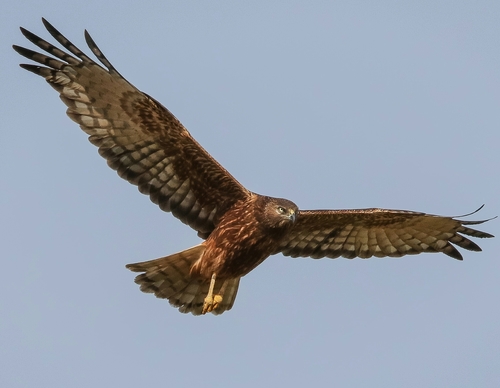
Swamp Harrier
Circus approximans
The Swamp Harrier is the elegant low-glider of the wetlands, easily recognized by its steady 'V-shaped' flight and striking white rump. A resilient survivor and master scavenger, it brings a touch of wild majesty to the rural and suburban fringes.
Quick Identification
Size
Length: 50–60 cm (20–24 in) | Wingspan: 120–145 cm (47–57 in) | Weight: 600–1100 g (1.3–2.4 lbs)
Colors
Dark chocolate brown upperparts; pale buff to rufous underparts with dark streaks; conspicuous white or pale cream rump; yellow eyes in adults (brown in juveniles).
Key Features
- Distinctive 'V' shape (dihedral) when soaring
- White or pale cream rump patch visible in flight
- Owl-like facial disc used for locating prey by sound
- Long, slender yellow legs and unfeathered tarsi
When You’ll See Them
Behavior
The Swamp Harrier, or Kāhu, is a master of low-altitude surveillance. Unlike many hawks that soar at great heights, the harrier is most often seen gliding just a few meters above the ground, rocking slightly from side to side as it navigates wind currents. They are highly methodical hunters, using a combination of keen eyesight and an owl-like facial disk that funnels sound to their ears, allowing them to detect small movements in thick vegetation.
While they are solitary hunters, they can be surprisingly social in areas with high food density. During the winter months, it is common to see multiple harriers congregating near wetlands or farmland where carrion is available. To humans, they are often seen as 'roadside' birds, frequently scavenging on roadkill, though they remain naturally wary and will take flight if a person approaches too closely on foot.
EverydayEarth exclusive
Camera Tips
Capturing the Swamp Harrier on a trail camera requires an understanding of their 'perching' and 'landing' habits. These birds are creatures of habit and love to survey their territory from elevated vantage points. If you have a fence line or a lone gate post overlooking an open field, this is the gold standard for camera placement. Mount your camera about 4 to 5 feet high, directly facing the top of the post where the bird is likely to land. Use a fast trigger speed setting, as harriers are quick to land and take off.
Because they are scavengers, harriers are one of the few raptors that can be reliably drawn toward a camera using 'passive' lures. In a backyard or farm setting, placing the camera near an open patch of ground where you might leave out scraps (if local regulations allow) can result in spectacular ground-level footage. They are particularly interested in carcasses, so if a camera is placed near natural carrion, you are almost guaranteed a visit. Ensure the camera is angled slightly upward to capture the massive wingspan as they descend.
Lighting is crucial for identifying harriers. To see that iconic white rump patch and the streaking on the breast, try to position your camera so the sun is behind it during the peak morning hours. High-definition video mode is preferred over stills; the way a Swamp Harrier 'teeters' in the wind and manipulates its tail feathers is a signature behavioral trait that is much easier to identify in motion. If your camera allows for it, set a 15-20 second video clip length to capture the bird's full landing and scanning routine.
Finally, don't overlook the ground. While we think of them as sky-dwellers, Swamp Harriers spend a significant amount of time on the floor of tall grass or marshes. If you have a trail through long grass, a low-mounted camera (12-18 inches off the ground) can capture rare 'walking' footage as they forage for eggs or rodents. Just ensure the area in front of the lens is clear of waving grass blades to avoid hundreds of false triggers on windy days.
Similar Species
Species that look similar or are commonly confused with Swamp Harrier.
Spotted Harrier
The Spotted Harrier has a grey-blue back and distinctive white spots on its rufous underparts, lacking the Swamp Harrier's white rump.
Whistling Kite
Kites have a more rounded or 'clipped' tail and lack the distinct white rump and V-shaped gliding profile of the harrier.
Black Kite
Black Kites have a noticeably forked tail and a darker, more uniform plumage compared to the streaky Swamp Harrier.
Frequently Asked Questions
Record Swamp Harrier at your habitat
Connect a camera to start building your own species record — AI identifies every visitor automatically.