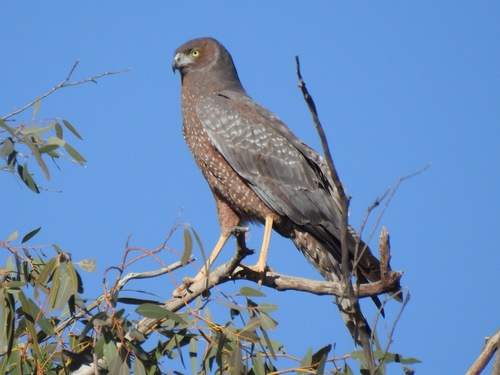
Spotted Harrier
Circus assimilis
The Spotted Harrier is an elegant low-altitude specialist, easily recognized by its 'smoke-grey' wings and striking chestnut face. A master of the open plains, it glides with effortless grace just above the tall grass.
Quick Identification
Size
Length: 50-60 cm (20-24 in); Wingspan: 120-145 cm (47-57 in); Weight: 400-750 g (0.9-1.6 lbs)
Colors
Blue-grey upperparts with fine white spotting; distinct chestnut-colored facial disks; rufous underparts heavily dappled with white spots; yellow eyes and long yellow legs.
Key Features
- Distinctive chestnut facial disks framed by grey
- Beautiful white spotting across the wings and underparts
- Slow, buoyant flight with wings held in a shallow 'V' shape
- Long, unfeathered yellow legs
When You’ll See Them
Behavior
The Spotted Harrier is a master of low-altitude surveillance, often referred to as the 'smoke hawk' due to its graceful, ghostly appearance in flight. Unlike many other birds of prey that soar at great heights, this species prefers to 'quarter' the ground, gliding just a few meters above the grass to surprise its prey. They are highly nomadic, often traveling long distances to follow outbreaks of mice or seasonal movements of ground-dwelling birds.
Unlike its relative, the Swamp Harrier, which nests in reeds, the Spotted Harrier is unique among harriers for being a tree-nester. They build relatively flat stick platforms in lone trees or small groves. While generally solitary and wary of human interaction, they can become quite bold when hunting over agricultural land, where they have learned that mowing or harvesting activity flushes out easy meals.
EverydayEarth exclusive
Camera Tips
To capture the Spotted Harrier on your AI camera, you need to think like a low-altitude hunter. Because these birds rarely land on the ground except to strike prey, your best chance for a clear shot is to mount your camera on a fence post or a lone paddock tree that offers a clear view of an open field. They frequently use these elevated 'perch points' to scan for movement before beginning a hunting run. Position the camera at chest height (around 4-5 feet), aimed across the top of the fence line or toward a favored perch.
Water is a significant draw for this species, especially in drier inland areas. If you have a livestock trough or a large, ground-level birdbath in an open area, place your camera 10 to 15 feet away. Harriers have a wide wingspan, so a bit of distance is necessary to keep the entire bird in the frame when they land to drink or bathe. Because they are shy, ensure your camera is well-camouflaged and lacks any 'status lights' that might flash and startle them during their approach.
In terms of settings, the 'High' PIR sensitivity is essential. Because harriers often glide slowly and silently, a low-sensitivity setting might not trigger the camera in time to catch the bird before it passes the frame. If your AI camera supports 'Burst Mode' or 'Action Mode,' enable it—this allows you to see the incredible detail of their spotted plumage and the unique chestnut facial disks as they bank and turn. Morning sessions are usually most productive, as the birds take advantage of the early light to hunt before the midday heat sets in.
Similar Species
Species that look similar or are commonly confused with Spotted Harrier.
Frequently Asked Questions
Record Spotted Harrier at your habitat
Connect a camera to start building your own species record — AI identifies every visitor automatically.