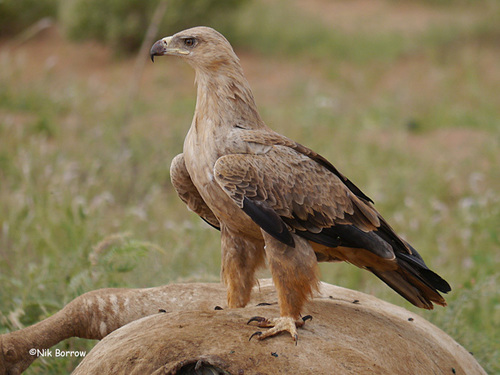
Tawny Eagle
Aquila rapax
A bold and versatile king of the savanna, the Tawny Eagle is as much a cunning pirate as it is a powerful predator. With its feathered boots and piercing gaze, this vulnerable raptor is a quintessential icon of the African and Indian wilderness.
Quick Identification
Size
Length: 60–75 cm (24–30 in); Wingspan: 157–190 cm (62–75 in); Weight: 1.6–3.1 kg (3.5–6.8 lbs)
Colors
Highly variable plumage ranging from pale cream to dark tawny-brown or rufous; yellow cere and feet with dark brown eyes.
Key Features
- Heavily feathered legs down to the toes (booted)
- Broad, long wings with deeply 'fingered' primary feathers
- Deeply gape that extends back to the middle of the eye
- Varies widely in color but generally lacks white patches on the back or wings
When You’ll See Them
Geographic range
Where Does the Tawny Eagle Live?
The Tawny Eagle is native to the vast, open landscapes of the African continent and the Indian subcontinent. It maintains a widespread but discontinuous presence across Sub-Saharan Africa, from the Sahel region down through the East African savannas to the tip of South Africa. In Asia, it is primarily found across the dry plains of India and Pakistan, with rare resident populations occasionally spotted in the southern reaches of the Middle East.
Basemap © OpenStreetMap contributors
Behavior
The Tawny Eagle is a master of versatility, often described as the most opportunistic of all large eagles. While it is a capable and bold predator in its own right—taking down prey as large as hares or small antelope—it is perhaps better known for its 'pirating' nature. It frequently engages in kleptoparasitism, aggressively harassing other birds of prey until they drop their catch, which the eagle then snatches for itself.
Unlike many other eagles that prefer solitary hunting, Tawny Eagles are quite social when it comes to scavenging. They are often among the first to arrive at a carcass, competing with vultures and jackals for a meal. They are resident breeders, staying within their territory year-round, and typically construct massive stick nests in the flat crowns of thorny trees like acacias, where they provide a high vantage point to scan the arid plains.
EverydayEarth exclusive
Camera Tips
To capture the majestic Tawny Eagle on a trail camera, focus on the 'resources of life' in arid environments. Because these eagles inhabit dry savannas, placement near a permanent water hole or a livestock trough is your best bet. Position your camera about 2 to 3 feet off the ground, angled slightly upward to catch the bird as it lands to drink or bathe. These eagles are cautious, so ensure the camera is well-camouflaged against tree trunks or brush.
If you are monitoring a larger property, placing a camera near a known carcass or a site where vultures gather can yield incredible action shots. Use a fast trigger speed (0.3 seconds or less) and set your camera to 'Burst Mode' to capture the rapid movement of the eagle dropping from the sky or competing with other scavengers. Because of their wide wingspan, a wide-angle lens setting is preferable to prevent the bird from being cropped out of the frame during takeoff.
Daytime settings are critical; ensure your exposure is balanced for high-contrast environments. Arid landscapes often have harsh midday sun, which can wash out the eagle's subtle brown tones. If your camera allows, slightly under-expose the image to preserve the detail in the 'tawny' feathers. The best shots usually occur between 10 AM and 3 PM when thermal currents are strongest and the eagles are most active in the air and visiting water sources.
Similar Species
Species that look similar or are commonly confused with Tawny Eagle.
Steppe Eagle
Larger with a deeper gape that extends past the eye; typically more migratory than the resident Tawny Eagle.
Wahlberg's Eagle
Smaller with a distinct small crest on the head and a straight-edged tail when soaring.
Lesser Spotted Eagle
Shows distinct white patches on the upper wing and has a different, more rounded wing profile.
Frequently Asked Questions
Record Tawny Eagle at your habitat
Connect a camera to start building your own species record — AI identifies every visitor automatically.