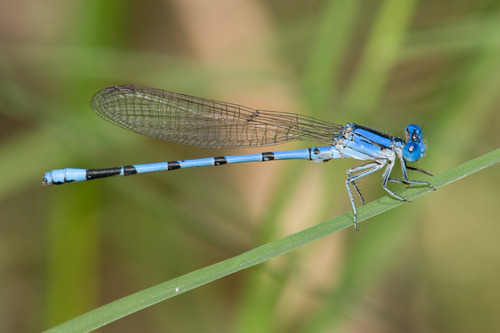
Aztec Dancer
Argia nahuana
With its striking electric blue body and delicate wings, the Aztec Dancer is a vibrant gem often found hovering over Southwest waterways.
Quick Identification
Size
Length: 33-40 mm (1.3-1.6 inches); Wingspan: 40-50 mm (1.6-2.0 inches)
Colors
Males are electric blue with black rings and markings; females occur in tan, brown, or blue forms with more extensive dark patterns.
Key Features
- Electric blue abdomen with black tip in males
- Large black humeral stripe on the thorax
- Clear wings with small dark spots at the tips
- Frequently seen flying in 'tandem' pairs
When You’ll See Them
Geographic range
Where Does the Aztec Dancer Live?
Native to the North American continent, the Aztec Dancer is a staple of the arid and semi-arid regions of the southwestern United States and Mexico. Its core range spans from the California coast through the Great Basin of Utah and down into the central Mexican plateau. While it is most concentrated in the Southwest, it can occasionally be found in neighboring states where permanent freshwater sources create suitable micro-habitats.
Basemap © OpenStreetMap contributors
Behavior
Aztec Dancers are agile aerial predators that spend their days patrolling the margins of slow-moving water. They are 'perch-and-wait' hunters, often seen resting on sun-warmed rocks, low-hanging twigs, or emergent aquatic vegetation. When they spot a small flying insect, they dart out with incredible speed, snatching their prey mid-air before returning to the same perch to eat.
These damselflies are highly social during the breeding season. Males are territorial and will defend prime sunny spots along a stream bank from rivals. One of their most fascinating behaviors is tandem flight; after mating, the male remains attached to the female's thorax using specialized appendages. Together, they fly as a single unit to find suitable underwater plants where the female can safely deposit her eggs.
EverydayEarth exclusive
Camera Tips
To capture high-quality images of the Aztec Dancer on a backyard camera, placement is the most critical factor. These insects are cold-blooded and rely on the sun for energy, so position your camera near a 'basking spot.' Look for flat, light-colored rocks or sturdy wooden garden stakes placed near the edge of a pond or water feature. Setting the camera at a low angle, roughly 12 to 15 inches from the perch, will allow you to capture the side profile and the intricate vein patterns in their wings.
Since damselflies are small, use a camera with a macro focus capability or a high-resolution sensor that allows for digital cropping. Set your trigger sensitivity to high, as their movements are incredibly fast. The best time to capture them is during the heat of the day, typically between late morning and mid-afternoon. If your camera has a 'burst' mode, enable it to increase the chances of catching a sharp image of their rapid flight or the precise moment they land.
You can encourage Aztec Dancers to visit your camera's field of view by providing 'habitat lures.' Rather than food, provide a variety of perching heights. A few taller reeds or thin bamboo stakes placed in a sunny spot near water are irresistible to them. Ensure the background is relatively simple—like dark water or green foliage—to help the bright blue of the male stand out. Avoid using motion-activated lights at night, as these insects are strictly diurnal and will be resting deep in the vegetation during the evening.
Similar Species
Species that look similar or are commonly confused with Aztec Dancer.
Frequently Asked Questions
Record Aztec Dancer at your habitat
Connect a camera to start building your own species record — AI identifies every visitor automatically.