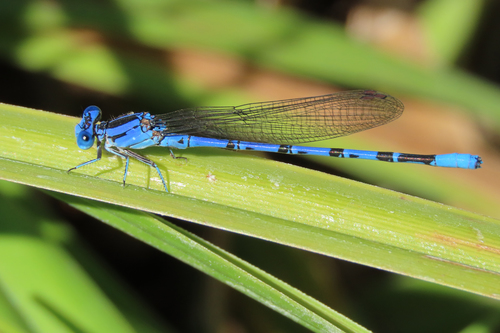
Vivid Dancer
Argia vivida
The Vivid Dancer is a jewel of the American West, known for its brilliant electric-blue color and its ability to thrive in the heat of desert springs. As Nevada's state insect, this damselfly is a favorite for backyard observers near water.
Quick Identification
Size
Length: 29–42 mm (1.1–1.7 inches); Wingspan: 40–50 mm (1.6–2.0 inches)
Colors
Males are a striking electric blue with black markings; females are polymorphic, appearing either light blue or tan/brown with black accents.
Key Features
- Vivid electric blue abdomen in males
- Black fork-shaped markings on the side of the thorax
- Large head with widely spaced eyes
- Wings held vertically together over the back when perched
When You’ll See Them
Geographic range
Where Does the Vivid Dancer Live?
The Vivid Dancer is a quintessential western species, primarily found across North America from southern Canada through the western United States and into Mexico and Central America. Its core range includes the Great Basin, where it is famously recognized as the state insect of Nevada, and it thrives in the spring systems of the Rocky Mountains and Pacific Coast. While primarily native to these regions, they are highly localized around permanent water sources that offer stable temperatures year-round.
Basemap © OpenStreetMap contributors
Behavior
Vivid Dancers are energetic and highly visible damselflies, frequently seen perching on sun-warmed rocks or vegetation near moving water. Unlike many other damselflies that prefer shade, these insects are sun-lovers and utilize sophisticated thermoregulation to maintain activity across a wide range of temperatures. You will often see them basking with their bodies flat against stones to absorb heat or moving to the underside of leaves to cool down during the peak of summer.
As predators, they are exceptionally agile in flight, performing short, darting maneuvers to snatch gnats and other small insects out of the air. They are also known for their territorial nature; males will vigorously defend prime perching spots along a stream to ensure access to passing females. Their life cycle is deeply tied to the water, where they spend their larval stage as aquatic predators before emerging for their brief but vibrant adult lives.
EverydayEarth exclusive
Camera Tips
Capturing the Vivid Dancer on an AI-powered camera requires focusing on their favorite perching spots rather than the open air. Since these damselflies are 'perchers' rather than 'flyers,' place your camera near sun-exposed rocks, low-hanging branches, or flat stones along the edge of a stream or garden pond. Position the lens about 1 to 2 feet from the ground or water surface, angling it slightly upward to capture the sky or a contrasting background to make their brilliant blue color pop against the environment.
Because they are relatively small, use a macro lens attachment if your camera supports it, or set the focus to a fixed point on a likely perching rock where you have seen them previously. To attract them to a specific spot for your camera, ensure there is a clear, sunny patch near moving water. They are particularly active during the warmest parts of the day, so configure your camera's motion sensitivity to trigger more frequently between late morning and mid-afternoon when the sun is at its zenith.
Avoid using traditional food baits, as damselflies are visual hunters and only respond to live prey. Instead, a 'lure' of moving water from a small solar fountain or a trickling pump can attract many insect species, including the Vivid Dancer, which are drawn to the sound and humidity of running water. For the best results, use a high shutter speed or a camera with a fast trigger time to catch them in flight or just as they land, as their movements are quick and erratic. During the cooler autumn months, focus your cameras on darker rocks that retain heat, as the damselflies will linger there longer to stay warm.
Similar Species
Species that look similar or are commonly confused with Vivid Dancer.
Frequently Asked Questions
Record Vivid Dancer at your habitat
Connect a camera to start building your own species record — AI identifies every visitor automatically.