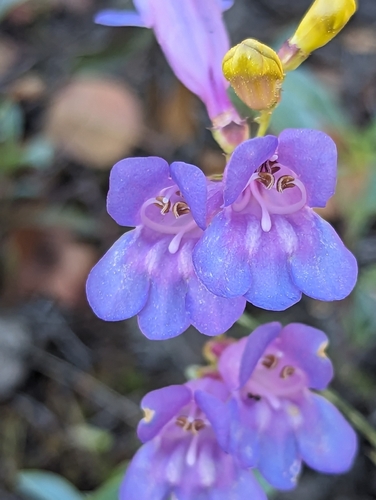
Azure Penstemon
Penstemon azureus
A striking mountain perennial known for its electric blue funnel-shaped flowers and waxy, silver-green foliage. It is a vital nectar source for hummingbirds and native bees in the rugged ranges of the Pacific Northwest.
Quick Identification
Size
Height ranges from 10–70 cm (4–28 inches) with a spread of 30–60 cm (12–24 inches)
Colors
Brilliant azure blue to deep violet-purple flowers; foliage is a distinct glaucous blue-green or gray-green
Key Features
- Funnel-shaped blue to purple flowers in whorled clusters
- Waxy, blue-gray foliage with an opposite leaf arrangement
- Hairless, upright stems that may be woody at the very base
- Sterile stamen (staminode) is typically hairless and expanded at the tip
When You’ll See Them
Geographic range
Where Does the Azure Penstemon Live?
The Azure Penstemon is native to the western United States, specifically the mountainous regions of the Pacific Northwest. Its range is concentrated in the rugged highlands of northern California and southern Oregon, where it thrives in the Klamath Mountains and the northern Sierra Nevada. You will most often find it painting the slopes of the southern Cascade Range, particularly in areas where forest fires or geological shifts have created sunny openings in the timberline.
Basemap © OpenStreetMap contributors
Behavior
The Azure Penstemon is a resilient perennial wildflower that serves as a cornerstone of the mountain ecosystem. Unlike many delicate garden flowers, it is adapted to the harsh conditions of rocky slopes and high-elevation clearings. It undergoes a seasonal cycle of growth, emerging with striking waxy, blue-tinted leaves in early spring before producing its signature 'azure' blooms as the temperatures rise in late spring and early summer.
This species is a primary draw for high-altitude pollinators. It operates as a biological magnet for hummingbirds and long-tongued bees, such as bumblebees and mason bees, which are specifically built to reach the nectar at the base of its tubular flowers. The plant stays relatively stationary, but its flowers are known to track the sun slightly, ensuring they are visible to flying insects during the peak heat of the day.
EverydayEarth exclusive
Camera Tips
To successfully capture the Azure Penstemon on a trail camera, you should treat the plant as the 'stage' for the local wildlife. Place your camera on a low-profile stake or a small flexible tripod about 12 to 18 inches off the ground. Angle the lens slightly upward to catch the full length of the flower spike. This low-angle perspective is ideal for capturing hummingbirds as they hover at the flower mouths, which is one of the most sought-after shots for backyard naturalists.
Because these flowers thrive in bright, mountain sun, glare can be an issue. The waxy (glaucous) coating on the leaves can reflect sunlight and wash out the image. If your camera has adjustable settings, try to set a slightly faster shutter speed or decrease the exposure compensation to preserve the deep, electric blue color of the petals. The best lighting occurs during the 'golden hours' of 7-9 AM when the sun first hits the mountain slopes, providing soft side-lighting that highlights the texture of the bells.
For those using AI-powered cameras, set the trigger sensitivity to high. While the plant doesn't move, the rapid entry of a bumblebee or the darting motion of a hummingbird requires a quick trigger to avoid capturing an empty frame. If your camera supports time-lapse mode, consider setting it to take one photo every 15 minutes over a 48-hour period during peak bloom in June. This will create a stunning visual record of the flowers opening and the high volume of insect traffic they attract.
Similar Species
Species that look similar or are commonly confused with Azure Penstemon.
Frequently Asked Questions
Record Azure Penstemon at your habitat
Connect a camera to start building your own species record — AI identifies every visitor automatically.