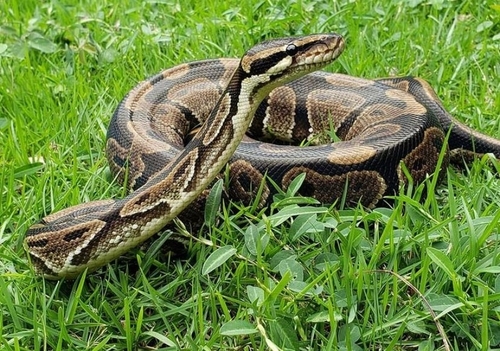
Ball Python
Python regius
The Ball Python is a master of disguise and the most iconic small python of the African savanna. Known for its gentle nature and beautiful golden-brown patterns, this nocturnal resident is a favorite for wildlife observers seeking to glimpse the hidden world of Africa's grasslands.
Quick Identification
Size
90-182 cm (3-6 ft) in length; typically weighs 1.2-2.2 kg (2.6-5 lbs)
Colors
Dark brown or black base with large, irregular blotches of light brown, tan, or gold; belly is typically white or cream with occasional black speckles
Key Features
- Stocky, heavy-bodied build
- Triangular head with heat-sensing labial pits
- Tucks into a spherical ball when threatened
- Smooth, shiny scales with distinct gold-brown patterning
When You’ll See Them
Geographic range
Where Does the Ball Python Live?
Native to the African continent, the Ball Python occupies a wide latitudinal belt across West and Central Africa. Its core range extends from the grasslands of Senegal and Guinea-Bissau eastward through the Ivory Coast, Ghana, and Nigeria, reaching into Cameroon and the Central African Republic. While they are most abundant in the semi-arid regions of West Africa, they also inhabit parts of South Sudan and Uganda, thriving in areas where open savanna meets the forest edge.
Basemap © OpenStreetMap contributors
Behavior
The Ball Python is a predominantly nocturnal and terrestrial constrictor known for its incredibly docile and shy temperament. Unlike more aggressive snakes that may strike when threatened, this species has evolved a unique defense mechanism: it tightly coils its body into a compact ball with its head protected in the center, earning it its common name. In the wild, they are often found utilizing abandoned rodent burrows or termite mounds as shelters during the day to escape the heat and avoid predators.
While they are largely solitary creatures, they are highly active at night, especially during the rainy season when humidity is higher. They are ambush predators, meaning they sit and wait for prey to pass by rather than actively hunting over long distances. In areas where they coexist with humans, such as agricultural regions in West Africa, they are often tolerated or even welcomed because they provide natural pest control by feeding on crop-destroying rodents.
EverydayEarth exclusive
Camera Tips
To capture high-quality footage of a Ball Python, camera placement is everything. These snakes are strictly terrestrial and stay close to the ground, so you should mount your camera very low—ideally between 6 and 12 inches (15-30 cm) off the ground. Angle the lens slightly downward to cover the forest floor or a specific trail. They are fond of using 'micro-highways' like the edges of fallen logs, stone walls, or the base of termite mounds, which make excellent focal points for your lens.
Because they are nocturnal, you must use a camera with excellent infrared (IR) capabilities. 'No-glow' or 'Black IR' LEDs are highly recommended because, while Ball Pythons cannot see the IR light, they have extremely sensitive heat-sensing pits along their lips. Traditional 'low-glow' LEDs may emit enough thermal energy or faint light to make a shy python retreat before you get a good shot. Set your camera to video mode with a 15-30 second duration to capture their slow, deliberate movement patterns.
Timing your monitoring with the weather can significantly increase your success rate. Ball Pythons are much more active when the humidity is high. Setting up your gear just before a rainstorm or during the humid nights of the wet season is ideal. If you are in their native range, look for areas with high rodent activity; a backyard with woodpiles or tall grass that attracts mice will naturally attract these pythons. Avoid using artificial baits, as these snakes respond primarily to the heat signatures and scent trails of live prey.
Similar Species
Species that look similar or are commonly confused with Ball Python.
Frequently Asked Questions
Record Ball Python at your habitat
Connect a camera to start building your own species record — AI identifies every visitor automatically.