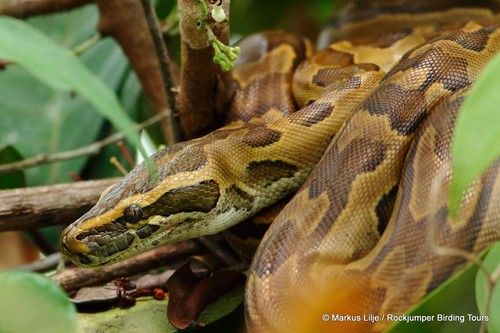
African Rock Python
Python sebae
The African Rock Python is Africa's largest snake, a powerful constrictor that rules the water's edge and the savanna floor alike. With its intricate 'spearhead' markings and massive girth, it is one of the most awe-inspiring reptiles you can capture on a trail camera.
Quick Identification
Size
Typically 3 to 5.5 metres (10 to 18 feet) in length; can weigh between 44 to 91 kg (97 to 200 lbs).
Colors
Tan, beige, or olive background with dark brown, irregular blotches that are often outlined in black and white. Head features a distinctive dark 'spearhead' marking.
Key Features
- Large triangular head with a dark spearhead-shaped mark on top
- Massive, thick-bodied build with a distinct neck
- Irregular dark blotches along the back and sides
- Two light-colored lines forming a 'V' shape on the snout
When You’ll See Them
Geographic range
Where Does the African Rock Python Live?
Native to the diverse ecosystems of Sub-Saharan Africa, the African Rock Python is found from the western coast in Senegal across to Ethiopia and Somalia. Its core range spans the tropical belt of Central Africa, including the Democratic Republic of the Congo, and extends southward toward the northern borders of South Africa. Additionally, a small, invasive population has established itself in the Florida Everglades of the United States, stemming from the international pet trade.
Basemap © OpenStreetMap contributors
Behavior
The African Rock Python is a formidable, solitary predator known for its opportunistic nature. While they are primarily terrestrial, they are excellent swimmers and often spend long periods submerged in water or basking on banks. These snakes are ambush specialists, using their heat-sensing pits to detect warm-blooded prey in the dark. Unlike many other large pythons, the African Rock Python is noted for its particularly defensive temperament; it is quick to strike and coil if it feels cornered or threatened.
As they mature, their behavior shifts from being somewhat arboreal (climbing trees to hunt birds) to almost entirely ground-dwelling. They are most active at night, though they are frequently seen during the day soaking up the sun to regulate their body temperature. In settled areas, they may come into conflict with humans as they are drawn to the easy meals provided by livestock, poultry, or even domestic pets.
EverydayEarth exclusive
Camera Tips
Capturing an African Rock Python on camera requires a focus on low-to-the-ground perspectives. Place your camera no more than 6 to 12 inches off the ground, angled slightly upward or level with a known game trail or water entrance. Because these snakes are incredibly heavy, they often leave 'slither tracks'—wide, straight-line depressions in soft sand or mud. If you find these, you have found a highway for a python. Aim your camera at a bottleneck where the trail meets a water source.
Since these snakes are highly active at night, ensure your camera has a high-quality infrared (IR) flash. Standard white flash can startle them and cause them to move out of the frame quickly. A 'No-Glow' IR camera is best to avoid detection. For settings, use a fast trigger speed (under 0.5 seconds) and set the camera to take 'Bursts' of 3-5 photos. Their movement can be deceptive; they look slow, but a large python can move its front half with surprising speed when it senses movement.
During the cooler months, look for sun-drenched rocky outcrops or south-facing banks near water. These are prime basking spots where the python will remain stationary for hours, allowing for high-detail daytime captures. Avoid using food bait, as this can attract scavengers like hyenas that might damage your equipment; instead, focus on natural funnels like gaps in fences or narrow paths between thickets.
Similar Species
Species that look similar or are commonly confused with African Rock Python.
Southern African Python
Very similar, but typically has slightly smaller scales on the head and a more fragmented pattern on the top of the snout.
Burmese Python
Found in Asia; has a more defined, clean 'puzzle' pattern and generally lacks the sub-ocular mark found on the Rock Python.
Ball Python
Much smaller (max 5ft) with a rounder head and a habit of curling into a tight ball when threatened.
Frequently Asked Questions
Record African Rock Python at your habitat
Connect a camera to start building your own species record — AI identifies every visitor automatically.