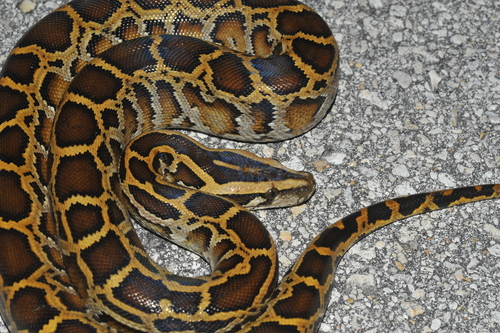
Burmese Python
Python bivittatus
One of the largest snakes on the planet, the Burmese Python is a master of camouflage and a powerful ambush predator. Whether navigating the jungles of Asia or the marshes of Florida, its presence defines the ecosystem.
Quick Identification
Size
Typically 3.7–5 meters (12–16 ft), but can reach 5.7 meters (19 ft); weight ranges from 40–90 kg (90–200 lbs).
Colors
Tan or yellowish-brown base with dark brown, irregularly shaped blotches outlined in black; belly is usually pale or cream-colored.
Key Features
- Dark, puzzle-like blotches on a tan background
- Distinct dark arrow-shaped marking on top of the head
- Massive, thick-bodied build
- Vertical pupils and heat-sensing pits along the upper lip
When You’ll See Them
Geographic range
Where Does the Burmese Python Live?
The Burmese Python is native to the humid tropics of Southeast Asia, where it thrives in the river basins and jungles of Myanmar, Thailand, Vietnam, and Southern China. In recent decades, it has established a massive and ecologically damaging invasive population in the United States, specifically throughout the Florida Everglades and surrounding wetlands. This species is highly adaptable to any environment that offers consistent warmth and high humidity.
Basemap © OpenStreetMap contributors
Behavior
Burmese Pythons are solitary, nocturnal giants that spend much of their lives hidden in thick vegetation or submerged in water. As excellent swimmers, they can stay underwater for up to 30 minutes, using this stealth to ambush prey near the water's edge. While they are primarily ground-dwellers as adults due to their immense weight, juveniles are surprisingly agile and frequently climb trees to hunt or seek safety.
These snakes are ambush predators that rely on camouflage rather than speed. They spend long periods motionless, waiting for a meal to cross their path, at which point they strike with lightning speed and kill through constriction. In areas where they are invasive, such as Florida, they have shown little fear of human-altered landscapes, often utilizing drainage culverts and canal banks as travel corridors.
EverydayEarth exclusive
Camera Tips
To capture a Burmese Python on camera, placement is everything. Because these snakes are heavy-bodied and stay low to the ground, set your camera just 6 to 12 inches off the deck. Aim the lens along 'edges'—where tall grass meets a water line, or along the base of a fence or stone wall. They often use these linear features as guides while navigating. If you are in a wetland area, focus on sunny logs or banks where they might haul out to bask during the cooler morning hours.
Since they are primarily nocturnal, high-quality infrared (IR) flash is essential. Ensure your camera has a fast trigger speed, as while the snake moves slowly, its head can strike or move out of frame quickly. Use a wide-angle lens setting if available, as these snakes can be significantly longer than a standard camera's field of view. Setting your camera to 'Video' or 'Hybrid' mode is often better than 'Photo' alone; a 10-20 second clip allows you to see the full length of the snake as it crawls past, which is much more impressive than a single shot of its midsection.
Regarding settings, set the PIR (Passive Infrared) sensitivity to 'High.' Because snakes are cold-blooded, they don't always trigger motion sensors that rely on a heat differential between the animal and the background. A high sensitivity setting increases the chance that the camera detects the subtle movement. Avoid using scent lures unless you are a professional, as attracting large predators to residential backyards can be dangerous for pets and local wildlife.
Similar Species
Species that look similar or are commonly confused with Burmese Python.
Frequently Asked Questions
Record Burmese Python at your habitat
Connect a camera to start building your own species record — AI identifies every visitor automatically.