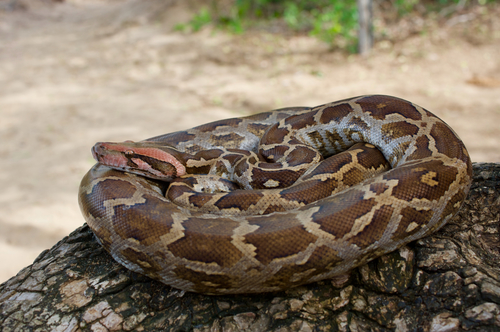
Indian Python
Python molurus
A master of camouflage and a silent guardian of the forest, the Indian Python is one of the world's most impressive non-venomous constrictors. Discover how to spot this gentle giant in its natural riverside habitats.
Quick Identification
Size
Usually 3 metres (9.8 feet) but can reach up to 4.5 metres (14.8 feet). Weight typically ranges from 30-55 kg (66-121 lbs).
Colors
Tan, yellowish, or grayish base with irregular dark brown or blackish blotches; belly is cream or white with darker spots.
Key Features
- Large arrow-shaped marking on top of the head
- Heat-sensing pits along the upper lip scales
- Massive, heavy-bodied build with a relatively short tail
- Dark horizontal stripe running through each eye
When You’ll See Them
Geographic range
Where Does the Indian Python Live?
The Indian Python is native to the vast and varied landscapes of the Indian subcontinent and parts of Southeast Asia. Its core range spans across India, Pakistan, Sri Lanka, Nepal, and Bangladesh, where it thrives in environments ranging from humid jungles to arid scrublands. While it is a resident species in these regions, its populations are increasingly fragmented by urban development, though it remains an iconic fixture of South Asian wilderness.
Basemap © OpenStreetMap contributors
Behavior
The Indian Python is a primarily nocturnal, solitary reptile that spends much of its time moving slowly and deliberately through its environment. Despite their formidable size, they are generally lethargic and shy, preferring to avoid human contact. They are excellent swimmers and are frequently found near water sources, often remaining submerged for several minutes while waiting for prey to approach the water's edge.
As ambush predators, they utilize a combination of visual cues and sensitive heat-pits to detect warm-blooded animals in total darkness. Once they strike, they kill by constriction, wrapping their powerful coils around the prey to stop blood flow. While they are non-venomous and rarely aggressive toward humans unless directly provoked, their sheer size and strength require respectful distance in the wild.
EverydayEarth exclusive
Camera Tips
To capture an Indian Python on camera, placement is everything. Since these are heavy-bodied, ground-dwelling reptiles, your camera should be mounted no more than 12 to 18 inches off the ground. Aiming the lens slightly downward across a known game trail or along the edge of a water body will provide the best profile shots. Because they are ectothermic (cold-blooded), their thermal signature may not always trigger standard PIR sensors if the ambient temperature is very close to their body temperature; setting your camera to a 'high sensitivity' PIR mode or using time-lapse intervals during the night can increase your chances.
Water is a massive draw for this species. If you have a backyard pond or live near a creek, positioning your camera near the water's edge is your best bet. Pythons often use the same paths repeatedly, so look for 'snake tracks'—wide, straight drag marks in soft mud or sand. Avoid using high-intensity white flashes, which can startle the snake and cause it to flee; instead, opt for 'No Glow' infrared LEDs to capture their natural nocturnal behavior without detection.
Seasonal timing is also critical. In many parts of their range, Indian Pythons are most active during the transition into the rainy season or on particularly humid nights. During the heat of the day, they often retreat into burrows or thick vegetation, so focus your monitoring on the hours between dusk and midnight. If you are using a trail camera in a suburban setting, check near woodpiles or rocky outcroppings where rodents—their primary food source—are likely to congregate.
Similar Species
Species that look similar or are commonly confused with Indian Python.
Frequently Asked Questions
Record Indian Python at your habitat
Connect a camera to start building your own species record — AI identifies every visitor automatically.