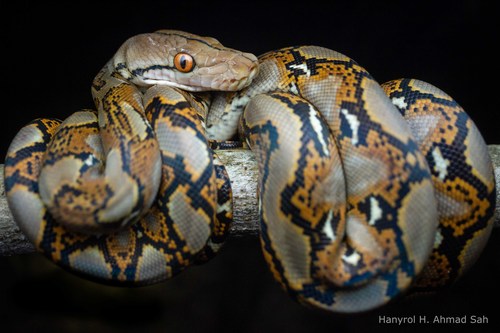
Reticulated Python
Malayopython reticulatus
The world's longest snake and a masterpiece of natural camouflage, the Reticulated Python is a silent giant of the Southeast Asian tropics. From remote jungles to urban waterways, these incredible constrictors are the ultimate nocturnal ambush predators.
Quick Identification
Size
Length: 1.5–6.5 m (4.9–21.3 ft), occasionally longer; Weight: 1–75 kg (2.2–165 lbs), with rare specimens exceeding 150 kg
Colors
Intricate geometric pattern of yellow, light brown, and black diamonds or 'nets' on a tan or olive background; iridescent sheen in sunlight
Key Features
- Complex net-like (reticulated) dorsal pattern
- Thin dark line running from the snout to the back of the head
- Heat-sensing pits along the upper and lower lip scales
- Vertical pupils and a distinctly triangular head
When You’ll See Them
Geographic range
Where Does the Reticulated Python Live?
Native to South and Southeast Asia, the Reticulated Python thrives across a vast geographical expanse. Its core range begins in Northeast India and extends through Bangladesh, Myanmar, Thailand, and Vietnam, reaching down into the dense rainforests of Malaysia. It is perhaps most famous for its presence across the thousands of islands in the Indonesian and Philippine archipelagos, where it has adapted to both coastal and inland environments. While primarily a jungle dweller, it has successfully established 'urban' populations in major cities like Singapore and Bangkok, where it thrives in green corridors and waterways.
Basemap © OpenStreetMap contributors
Behavior
The Reticulated Python is a solitary and primarily nocturnal ambush predator. It spends much of its time coiled in a hidden location, waiting for prey to pass within striking distance. They are remarkably adept swimmers and have been found far out at sea, which explains their successful colonization of many remote islands across the Indo-Pacific. While they are generally shy and avoid human contact, their sheer size makes large adults potentially dangerous if they feel cornered or mistakingly identify a human as prey.
In urban environments, these pythons have become surprisingly common by utilizing drainage systems and sewers as highways. They are highly efficient at controlling rodent populations in cities. During the day, they typically retreat to dark, cool spots—such as hollow logs, caves, or even the crawlspaces of houses—to digest their meals and regulate their body temperature. Their behavior is largely dictated by their metabolism; after a large meal, a python may remain motionless for several weeks.
EverydayEarth exclusive
Camera Tips
Capturing a Reticulated Python on a trail camera requires a specific strategy because they are ectothermic (cold-blooded). Most standard trail cameras use Passive Infrared (PIR) sensors that trigger based on heat signatures. Because a snake's body temperature often matches the ambient air, they may not trigger the camera if they are moving slowly. To combat this, set your camera's PIR sensitivity to 'High' or use a 'Time Lapse' mode with a frequent interval (e.g., every 1-5 minutes) to ensure you don't miss a passing giant.
Placement is critical. In a backyard or rural setting, aim your camera at low-lying areas near water sources, drainage pipes, or along the edges of dense brush where the snake might hunt. Position the camera very low to the ground—no higher than 15 to 30 centimeters (6 to 12 inches)—and angle it slightly upward. This 'snake's-eye view' will better capture the length of the body and the intricate patterns on the scales, which are essential for identification.
Because these pythons are most active at night, use a camera with high-quality 'No-Glow' infrared LEDs. This prevents the snake from being spooked by a visible flash and also keeps your equipment hidden from human passersby in suburban areas. Set your camera to record short video clips (15-30 seconds) rather than just still photos; the fluid movement and tongue-flicking behavior of the python are much more impressive to watch and help confirm the species in low-light conditions.
Similar Species
Species that look similar or are commonly confused with Reticulated Python.
Frequently Asked Questions
Record Reticulated Python at your habitat
Connect a camera to start building your own species record — AI identifies every visitor automatically.