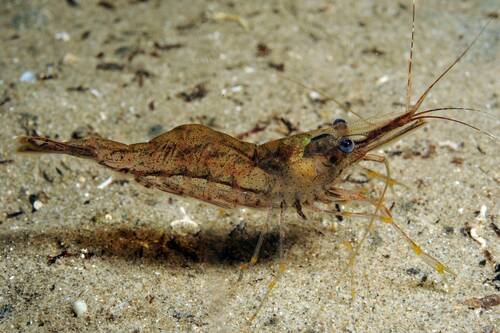
Baltic prawn
Palaemon adspersus
A master of disguise within the seagrass, the Baltic prawn is a vital member of the coastal ecosystem. Known for its striking translucent stripes and resilient nature, it is a favorite for underwater backyard observers.
Quick Identification
Size
Up to 70 mm (2.8 inches) in length, with females typically larger than males.
Colors
Transparent to pale yellowish-grey body with horizontal dark reddish-brown or black stripes on the carapace and abdomen.
Key Features
- Translucent body with dark horizontal stripes
- Straight, serrated rostrum with spots on the lower half
- Two pairs of prominent pincers
- Large, dark stalked eyes
When You’ll See Them
Geographic range
Where Does the Baltic prawn Live?
Native to the coastal waters of Europe, the Baltic prawn is most abundant in the brackish waters of the Baltic Sea and the Kattegat. Its range extends significantly through the North Sea, the Mediterranean, and the Black Sea, where it favors sheltered bays and estuaries. While primarily a European resident, it has been introduced to the Caspian Sea and has been documented in parts of the North American Atlantic coast.
Basemap © OpenStreetMap contributors
Behavior
The Baltic prawn is a highly social and active crustacean that thrives in the shelter of underwater vegetation. They are known for their 'cleaning' behavior, constantly picking through seagrass blades and substrate for food. While they can be found in large groups, they are competitive when it comes to food sources, often using their pincers to ward off rivals from a choice morsel.
These prawns are masters of camouflage, using their near-transparent bodies to blend into the flickering light of shallow waters. They are most active during the twilight hours, emerging from the densest parts of the Zostera beds to forage more openly. During the day, they remain wary of predators like perch, eels, and shorebirds, often tucking themselves deep into the base of seagrass or under submerged rocks.
EverydayEarth exclusive
Camera Tips
Capturing the Baltic prawn requires an underwater camera setup, as these creatures are strictly aquatic. For homeowners with coastal property or docks, the most effective method is to mount a waterproof action camera to a weighted frame or a pole. Submerge the camera to a depth of 0.5 to 1.5 meters, positioning it so the lens faces a patch of seagrass or a cluster of seaweed-covered rocks. This provides the natural backdrop where prawns are most likely to appear.
Since Baltic prawns are most active in low-light conditions, lighting is your biggest challenge. Direct, bright white light can be abrasive and may cause the prawns to flee. Instead, use a diffused, low-intensity light source or a camera with a high-quality low-light sensor. If your camera supports it, a red-filtered light can allow you to observe their natural behaviors without causing significant disturbance, as many crustaceans are less sensitive to the red end of the spectrum.
To guarantee activity in front of the lens, use a small mesh bait bag filled with crushed mussels, shrimp pellets, or a small piece of oily fish. Secure the bait bag just off-center in the frame; this draws the prawns into the field of view without the bag obstructing the primary shot. Late spring and early summer are the best times for this, as the prawns move into shallower, warmer waters to breed, resulting in much higher population densities near the shore.
Similar Species
Species that look similar or are commonly confused with Baltic prawn.
Frequently Asked Questions
Record Baltic prawn at your habitat
Connect a camera to start building your own species record — AI identifies every visitor automatically.