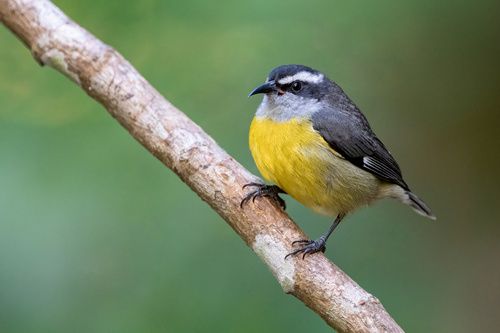
Bananaquit
Coereba flaveola
Often called the 'Sugar Bird,' the Bananaquit is a vibrant, bold visitor to tropical gardens. With its bright yellow belly and curved bill, this tiny nectar-thief is one of the most charismatic birds you'll find on your backyard camera.
Quick Identification
Size
Length: 10-11 cm (4-4.5 in); Wingspan: 18-20 cm (7-8 in); Weight: 7-11 g (0.25-0.4 oz)
Colors
Dark charcoal to black upperparts, bright yellow breast and belly, white throat, and a bold white stripe above the eye. Sexes appear similar, though juveniles are duller with a yellowish eyebrow.
Key Features
- Distinctive white eyebrow (supercilium)
- Bright yellow underparts and rump
- Sharp, downward-curved (decurved) black bill
- Frequent upside-down feeding posture
When You’ll See Them
Sightings on EverydayEarth
Jun 27, 2026
A male Thick-billed Euphonia lands on the feeder tray to feed on sliced oranges. It is soon joined by a Bananaquit on the right side of the platform, which uses its specialized curved bill to probe the fruit. Both birds are active and healthy, typical of the high-energy species found in this habitat.
Jun 19, 2026
A male Red-crowned Woodpecker is the primary visitor, spent several seconds pecking at and eating from orange slices arranged on the feeder tray. Toward the end of the clip, a small Bananaquit joins at the far left edge of the feeder to feed on the fruit.
Jun 17, 2026
A few small birds arrive at the feeder station in the morning light. A Bananaquit is seen visiting the red nectar feeder on the left and perching on a mossy branch, while a male Thick-billed Euphonia lands on the main platform to feed on slices of papaya and orange.
Geographic range
Where Does the Bananaquit Live?
The Bananaquit is native to the tropical Americas, boasting a massive range that stretches from southern Mexico through Central America and deep into South America as far as northern Argentina. It is a signature species of the Caribbean islands, found on nearly every island from the Bahamas down to Trinidad. While they are primarily tropical residents, they occasionally wander as vagrants into southern Florida, making them a prize find for North American birdwatchers in the Florida Keys.
Basemap © OpenStreetMap contributors
Behavior
Bananaquits are remarkably bold and energetic birds, often becoming quite tame around human habitations. They are famous for their 'nectar-robbing' technique, where they use their sharp, curved beaks to pierce the base of a flower to reach the nectar without pollinating the plant. This intelligence extends to their interactions with humans; in many Caribbean resorts and backyards, they are known as 'Sugar Birds' because they will hop onto outdoor dining tables to steal grains of sugar or sip from juice glasses.
Socially, they are usually seen alone or in pairs, though they may congregate in larger numbers around a particularly rich food source like a fruiting tree or a backyard feeder. They are constant movers, flitting rapidly between branches and frequently hanging upside down to reach difficult nectar sources. Their song is a series of high-pitched, buzzy notes that are a ubiquitous sound in tropical gardens.
EverydayEarth exclusive
Camera Tips
To capture the high-energy antics of the Bananaquit, your camera should be positioned near nectar sources or 'sugar stations.' These birds are incredibly bold, so you can place cameras closer to feeders than you might for more skittish species—aim for 3 to 5 feet away to get detailed shots of their curved bills and bright plumage. Since they are small and fast, a camera with a high trigger speed (0.2 seconds or less) is essential to catch them before they flit away.
Setting up a bird bath or a shallow water saucer can also provide excellent footage, as Bananaquits are frequent bathers. Mount your camera at 'bird-eye level'—roughly 4 to 6 feet high—on a fence post or tripod facing a flowering shrub like Hibiscus or Ixora. If you are using a feeder, opt for a platform or a hummingbird feeder with a perch, as Bananaquits prefer to sit while they drink rather than hover like hummingbirds.
Lighting is key for bringing out their yellow bellies. Try to position your camera so the sun is behind it during the morning hours, illuminating the bird’s front. If your camera has a 'burst mode' or high-speed video setting (60fps), use it to capture the rapid tongue movements they use when drinking nectar. In many tropical regions, they are active year-round, but you will see peak activity during the morning hours just after sunrise when nectar levels are highest.
Similar Species
Species that look similar or are commonly confused with Bananaquit.
Frequently Asked Questions
Record Bananaquit at your habitat
Connect a camera to start building your own species record — AI identifies every visitor automatically.