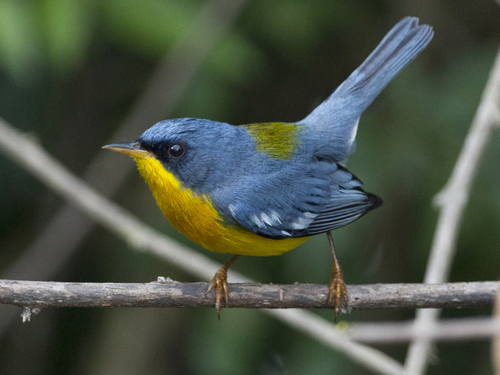
Tropical Parula
Setophaga pitiayumi
A vibrant, acrobatic gem of the neotropics, the Tropical Parula is a tiny power-house of energy known for its brilliant yellow breast and affinity for hanging mosses.
Quick Identification
Size
10-11 cm (4-4.5 in) long; wingspan of 17-18 cm (6.7-7.1 in); weight of 6-9 g (0.21-0.32 oz)
Colors
Blue-gray upperparts with an olive-green triangular back patch; bright yellow throat and breast; two white wing bars; males have a small black mask
Key Features
- Olive-green 'saddle' patch on the back
- Absence of white eye rings (unlike the Northern Parula)
- Bright yellow breast with orange-tinted wash in males
- Two prominent white wing bars
- Small, thin, sharply pointed bill
When You’ll See Them
Geographic range
Where Does the Tropical Parula Live?
Native to the Americas, the Tropical Parula occupies a massive geographic footprint spanning from the southernmost tip of Texas and northwest Mexico through Central America into South America. It is a common resident across the Amazon basin and coastal regions, stretching as far south as northern Argentina and Uruguay. This species is a year-round fixture in its range, only showing short-distance movements rather than the epic migrations seen in its northern relatives.
Basemap © OpenStreetMap contributors
Behavior
The Tropical Parula is a restless, energetic little bird that rarely stays still for more than a few seconds. It is a foliage-gleaner, meaning it spends most of its day acrobatically hopping through the canopy and mid-story of trees, often hanging upside down to pluck spiders, caterpillars, and small insects from the undersides of leaves. Unlike many other wood-warblers that migrate long distances, the Tropical Parula is largely sedentary, staying within its territory year-round.
While they are primarily solitary or found in pairs during the breeding season, they frequently join mixed-species foraging flocks during the winter months. They are highly dependent on epiphytes, particularly Spanish moss or lace lichen (Usnea), for nesting. In backyard settings, they are curious but cautious, often staying high in the trees, though they are known to descend for a shallow birdbath or a misting station during the heat of the day.
EverydayEarth exclusive
Camera Tips
To capture the Tropical Parula on a backyard camera, placement is everything. These birds are canopy-dwellers by nature, so mounting your camera at ground level will rarely yield results unless you have a specific draw. Instead, try mounting your camera 5 to 8 feet high, angled slightly downward toward a known perching branch or a hanging clump of Spanish moss, which they use for both foraging and nesting material.
The absolute best 'bait' for a Tropical Parula isn't food—it's water. They are highly attracted to the sound of moving water. A birdbath with a solar-powered dripper or a fine misting attachment will often lure them down from the high canopy for a drink or a bath. Position your camera about 3-4 feet from the water source and use a fast shutter speed or high-frame-rate video setting, as their movements are incredibly rapid and twitchy.
Because these birds are small and move fast, motion-trigger sensitivity should be set to high. If your camera allows for it, use a 'Pre-record' feature to ensure you don't miss the bird as it darts into the frame. Early morning light provides the best illumination for their vibrant yellow chests and blue-gray backs, so ensure your camera isn't facing directly into the rising sun to avoid silhouettes.
Similar Species
Species that look similar or are commonly confused with Tropical Parula.
Frequently Asked Questions
Record Tropical Parula at your habitat
Connect a camera to start building your own species record — AI identifies every visitor automatically.