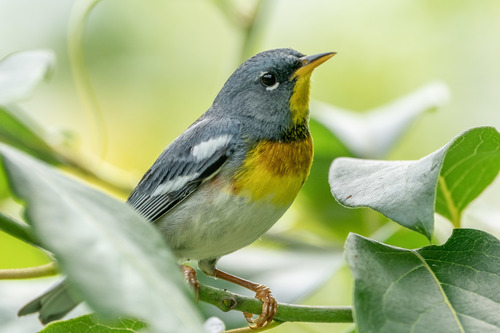
Northern Parula
Setophaga americana
A tiny jewel of the treetops, the Northern Parula is famous for its rising buzzy trill and its unique habit of nesting in hanging moss. This blue-and-yellow warbler is a highlight for backyard birders across eastern North America.
Quick Identification
Size
Length: 10–12 cm (4.3–4.7 in); Wingspan: 16–18 cm (6.3–7.1 in); Weight: 5–11 g (0.18–0.39 oz)
Colors
Blue-gray upperparts with an olive-green triangular patch on the back. Yellow throat and breast, white belly. Males feature a dark rusty-red and black band across the chest; females are duller and usually lack this band.
Key Features
- Broken white eye-ring (crescent-shaped above and below the eye)
- Bright yellow throat and breast contrasting with a white belly
- Distinctive olive-green 'saddle' on the middle of the back
- Two prominent white wing bars on blue-gray wings
When You’ll See Them
Geographic range
Where Does the Northern Parula Live?
Native to the eastern half of North America, the Northern Parula breeds in a broad arc from the southern boreal forests of Canada down to the Gulf Coast and Florida. As autumn approaches, these tiny travelers migrate across the Gulf of Mexico or along the coast to winter in the Caribbean, southern Mexico, and Central America. Because their nesting habits are so closely tied to specific hanging mosses and lichens, they are most common in mature woodlands where these plants are abundant.
Basemap © OpenStreetMap contributors
Behavior
The Northern Parula is a tireless bundle of energy, spending most of its time high in the forest canopy. They are highly active foragers, often seen hopping rapidly along branches or hovering momentarily to pluck insects from the underside of leaves. During the breeding season, males are persistent singers, delivering a buzzy, ascending trill that ends in a sharp, emphatic 'zip'—a sound that is often the first sign of their presence in a backyard or woodland.
While they are generally solitary during the summer, Northern Parulas often join mixed-species foraging flocks during migration and on their wintering grounds. They are not particularly shy but their preference for high branches can make them difficult to spot without binoculars. Their social interactions are primarily limited to territorial defense during the spring, where males will chase rivals away from their chosen nesting sites, which are almost always hidden within hanging clumps of moss or lichen.
EverydayEarth exclusive
Camera Tips
Capturing a Northern Parula on camera can be a challenge because they prefer the upper canopy. To bring them down to camera level, the absolute best tool is a water feature. A birdbath with a solar-powered dripper or a specialized bird mister is irresistible to these warblers, especially during the peak of spring and fall migration. Place your camera approximately 3 to 5 feet away from the water source, angled slightly downward to capture the bird as it splashes.
Since these birds are extremely small and fast, use a high shutter speed or a 'burst' mode setting on your AI camera to avoid motion blur. If you are using a trail camera, ensure the PIR (motion) sensor sensitivity is set to 'High' to detect their slight frames. Because they are most active in the early morning, position your camera facing north or south to avoid the harsh glare of the rising sun blowing out the delicate yellow and blue-gray details of their plumage.
In the southern United States, look for trees draped in Spanish moss; in the North, look for Old Man's Beard lichen (Usnea). If you have these in your yard, mount a camera on a nearby branch or a pole about 6–10 feet high. Parulas are extremely curious about these nesting materials in early May. Setting your camera to record short video clips (10-15 seconds) is often more rewarding than still photos, as it captures their unique 'shivering' foraging style and distinctive buzzy song.
Similar Species
Species that look similar or are commonly confused with Northern Parula.
Tropical Parula
Lacks the white eye-crescents of the Northern Parula and has a darker face mask.
Yellow-throated Warbler
Larger with a long bill, a bold white eyebrow stripe, and black-streaked white flanks.
Nashville Warbler
Has a complete white eye-ring and lacks the blue-gray wing bars and olive back patch.
Frequently Asked Questions
Record Northern Parula at your habitat
Connect a camera to start building your own species record — AI identifies every visitor automatically.