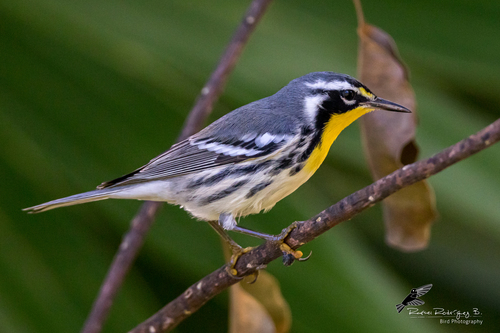
Yellow-throated Warbler
Setophaga dominica
A methodical 'creeper' of the high canopy, the Yellow-throated Warbler is a master of the treetops. With its radiant yellow throat and bold facial mask, it brings a touch of elegance to mature woodlands and suburban pines.
Quick Identification
Size
Length: 13-14 cm (5.1-5.5 in); Wingspan: 20-21 cm (7.9-8.3 in); Weight: 9-11 g (0.3-0.4 oz)
Colors
Brilliant yellow throat and upper breast; slate-gray upperparts; white belly with black streaks along the flanks; black triangular face mask with a white eyebrow and a white patch on the side of the neck. Males and females are nearly identical.
Key Features
- Vivid yellow throat and chin
- Bold black triangular face mask with white eyebrow
- Slate-gray back with two white wing bars
- Distinctive creeping movement along horizontal branches
- Longer, sturdier bill than most warblers
When You’ll See Them
Behavior
The Yellow-throated Warbler is often referred to as the 'nuthatch of the warbler world' due to its unique foraging style. Unlike many other warblers that flit restlessly through foliage, this species is known for creeping slowly and methodically along large horizontal branches and up tree trunks. They probe deep into bark crevices and clusters of pine needles to find hidden insects, often hanging upside down to reach their prey.
While they are mostly found high in the canopy of mature trees, they are quite vocal. Their song is a clear, descending series of whistled notes that often reveals their presence even when they are hidden by leaves. They are generally solitary during the breeding season but may join mixed-species flocks of chickadees and titmice during the winter or migration, following the group as they move through the woods.
EverydayEarth exclusive
Camera Tips
To capture high-quality footage of a Yellow-throated Warbler, you must account for their preference for high altitudes. The single most effective way to bring them within range of a backyard camera is with water. Use a pedestal birdbath or a hanging water feature equipped with a 'dripper' or 'wiggler.' The sound of moving water is an irresistible magnet for these birds, coaxing them down from the canopy. Position your camera at eye-level with the water source, ideally 3 to 4 feet away, to capture the intricate details of their facial mask and yellow throat.
If you have mature pine or sycamore trees, you can attempt to mount a camera on a sturdy horizontal limb about 10-15 feet up. Because this species 'creeps' rather than flits, they stay in the frame much longer than other warblers. Look for branches with thick, shaggy bark or patches of Spanish moss, as these are their favorite hunting grounds. Ensure the camera is angled to catch the side profile of the bird as it moves along the branch, which will highlight their unique foraging behavior.
In terms of settings, use a high trigger speed and set your camera to take 'burst' photos or short 10-12 second video clips. During the early spring or fall migration, you can also lure them to a specific spot by smeared suet or bark butter into the crevices of a tree trunk. Place the camera on an adjacent tree facing the baited area. This is one of the few warblers that will consistently visit suet if it is placed high enough and near a vertical trunk. Early morning light is crucial; try to position the camera with the sun at its back to illuminate the yellow throat without creating harsh shadows from the surrounding foliage.
Similar Species
Species that look similar or are commonly confused with Yellow-throated Warbler.
Black-and-white Warbler
Both species creep on bark, but the Black-and-white lacks any yellow and is strictly striped in black and white.
Grace's Warbler
Found in the Southwest; it has a yellow eyebrow and lacks the bold black triangular face patch of the Yellow-throated.
Yellow-rumped Warbler
Identified by the yellow patch on the rump and flanks, whereas the Yellow-throated's yellow is strictly on the throat.
Frequently Asked Questions
Record Yellow-throated Warbler at your habitat
Connect a camera to start building your own species record — AI identifies every visitor automatically.