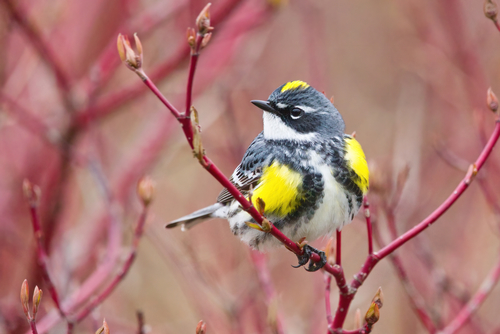
Yellow-rumped Warbler
Setophaga coronata
Affectionately known by birders as 'Butter-butts,' the Yellow-rumped Warbler is a hardy traveler and one of the most frequent visitors to backyard cameras. Whether they're darting after insects or feasting on winter berries, these energetic birds are a joy to discover in any garden.
Quick Identification
Size
Length: 4.7-5.5 in (12-14 cm); Wingspan: 7.5-9.1 in (19-23 cm); Weight: 0.4-0.5 oz (12-13 g)
Colors
Slate blue, gray, or brown upperparts with white or yellow throat; distinctive bright yellow patches on the rump, sides (flanks), and crown.
Key Features
- Bright yellow patch on the base of the tail (rump)
- Yellow patches on the sides of the chest
- Two white wing bars
- Thin, pointed beak for insect eating
When You’ll See Them
Behavior
Yellow-rumped Warblers are incredibly energetic and versatile birds. Unlike many other warblers that stay hidden in the high canopy, 'Butter-butts'—as they are affectionately known—frequently descend to lower branches and even the ground. They are famous for their flycatching ability, often darting out from a perch to snatch an insect mid-air before returning to the same spot.
During the winter, they are highly social and often form large, loose flocks with other songbirds like Nuthatches and Chickadees. They are uniquely hardy among warblers because they possess the ability to digest the wax found in bayberries and wax myrtles, allowing them to winter much further north than their insect-dependent cousins. They are generally tolerant of humans and will readily visit backyards that offer water or suitable winter food.
EverydayEarth exclusive
Camera Tips
To capture high-quality footage of Yellow-rumped Warblers, your best bet is to focus on a water feature. These birds are highly attracted to the sound of moving water. Place your AI camera 3 to 5 feet away from a birdbath equipped with a dripper or a small fountain. Position the camera at 'bird-eye level'—roughly 3 to 4 feet off the ground—rather than looking down from a high mount, to capture the intricate details of their plumage and their characteristic tail-flicking behavior.
In the winter months, you can lure them directly into your camera's field of view by offering suet or peanut butter. While most warblers ignore feeders, 'Yellow-rumps' are frequent visitors. Try mounting a suet cage on a tree trunk and placing the camera on an adjacent branch or a tripod. If you have wax myrtle or juniper bushes in your yard, aim your camera at the berry clusters; the birds will return to these spots repeatedly throughout the day, providing excellent opportunities for 'natural' action shots.
Because these birds are incredibly fast, use a high-sensitivity motion trigger setting. If your camera allows for manual shutter speed control, aim for at least 1/1000th of a second to freeze the motion of their wings during takeoff. Since their most identifying feature is the yellow rump, try to position your camera so it captures birds as they move away from the lens or perch sideways; a side-profile shot usually captures the 'butter-butt' and the yellow flank patches simultaneously.
Similar Species
Species that look similar or are commonly confused with Yellow-rumped Warbler.
Magnolia Warbler
Has a similar yellow rump but features a distinct wide black band at the end of the tail and much heavier black streaking on the underparts.
Pine Warbler
Lacks the bright yellow rump and crown patches; has a more consistent olive-yellow color on the chest and throat.
Palm Warbler
Identified by its constant tail-bobbing behavior and rufous (reddish) cap, lacking the specific yellow flank patches.
Frequently Asked Questions
Record Yellow-rumped Warbler at your habitat
Connect a camera to start building your own species record — AI identifies every visitor automatically.