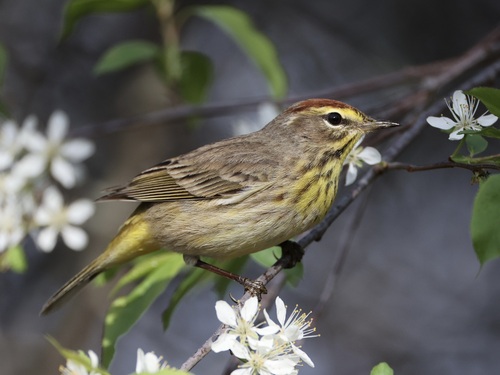
Palm Warbler
Setophaga palmarum
Look down, not up! This energetic ground-dweller is famous for its constant tail-bobbing and golden-yellow highlights, making it a favorite for backyard birdwatchers.
Quick Identification
Size
Length: 4.7–5.5 in (12–14 cm); Wingspan: 7.9–8.3 in (20–21 cm); Weight: 0.3–0.5 oz (8–15 g)
Colors
Brownish-olive upperparts with yellow or whitish underparts; prominent rusty cap during breeding season; yellow undertail coverts; dark eye-line and pale eyebrow.
Key Features
- Persistent downward tail-bobbing motion
- Rusty-colored crown (most visible in spring)
- Bright yellow feathers under the tail (undertail coverts)
- Forages primarily on the ground rather than in treetops
When You’ll See Them
Behavior
The Palm Warbler is a bit of an outlier in the warbler family. While most of its cousins are darting through high forest canopies, this bird is famously 'grounded.' You'll most often spot them scurrying across lawns, garden beds, or low-lying brush, looking more like a sparrow than a typical warbler. Their most endearing and recognizable trait is their near-constant tail-bobbing, a rhythmic downward flick they perform while standing or walking.
During migration, they are quite social and can often be found in 'mixed flocks' with sparrows and other warblers. While they aren't as bold as a chickadee, they are relatively tolerant of human presence if you remain still. They are active hunters, often making short 'sallying' flights to catch an insect in mid-air before returning to the ground to continue their search.
EverydayEarth exclusive
Camera Tips
Since Palm Warblers are dedicated ground-foragers, the biggest mistake people make is mounting their camera too high. To get the best shots, place your camera just 6 to 12 inches off the ground. Use a short tripod or a 'ground spike' mount near the edge of a garden bed or a patch of short grass where you've seen birds hopping. Angle the camera slightly upward to capture the bird's underside, which highlights their distinctive yellow undertail coverts.
Water is a much more effective lure for Palm Warblers than a traditional bird feeder. They are rarely interested in seeds, but a shallow, bubbling birdbath or a ground-level 'dripper' will bring them right into your camera's frame. If you can position your camera near a puddle or a low water feature, you'll likely catch them not just foraging, but also bathing, which makes for fantastic video footage.
Because these birds are small and move with quick, jerky motions, set your camera to its highest sensitivity and use a 'Burst Mode' (3-5 photos per trigger). This ensures you catch that perfect moment when the tail is flicked up or the rusty cap is clearly visible. If your camera supports it, a high frame-rate video setting is even better for capturing their unique rhythmic bobbing behavior, which is their most reliable identification trait.
Timing is everything with this species. In the southern United States, you can find them all winter, but for the rest of North America, they are early-season migrants. Get your cameras out in early April before the other warblers arrive. They are often the first sign of spring, appearing in backyards when the ground is just starting to thaw and insects begin to emerge.
Similar Species
Species that look similar or are commonly confused with Palm Warbler.
Frequently Asked Questions
Record Palm Warbler at your habitat
Connect a camera to start building your own species record — AI identifies every visitor automatically.