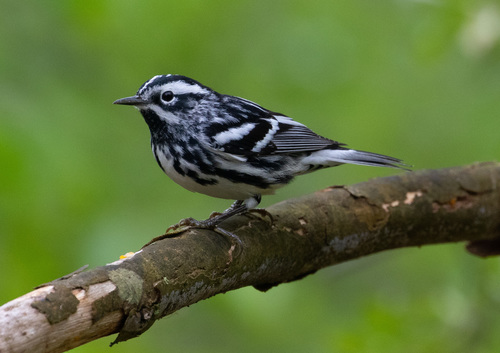
Black-and-white Warbler
Mniotilta varia
Often mistaken for a nuthatch due to its unique habit of scurrying up and down tree trunks, the Black-and-white Warbler is a striking, zebra-striped visitor to backyard woodlots. Its bold patterns and acrobatic foraging make it one of the most charismatic warblers to capture on camera.
Quick Identification
Size
Length: 11.5–13 cm (4.5–5.1 in), Wingspan: 18–22 cm (7.1–8.7 in), Weight: 8–15 g (0.28–0.53 oz)
Colors
Bold black and white longitudinal stripes across the entire body. Males have a black throat and cheek, while females and immatures have a white throat and buff-colored wash on the flanks.
Key Features
- Zebra-like black and white streaking over the entire body
- Distinctive nuthatch-like creeping behavior on tree trunks
- Extra-long hind claw for gripping bark
- Slightly downcurved, needle-like bill
When You’ll See Them
Geographic range
Where Does the Black-and-white Warbler Live?
Native to the North American continent, the Black-and-white Warbler breeds across a vast territory stretching from the boreal forests of central Canada through the eastern and central United States. As a highly migratory species, it travels thousands of miles each year to winter in the tropical climates of Florida, the Caribbean islands, Central America, and as far south as the northern regions of Peru. Its ability to utilize a wide variety of wooded habitats makes it a frequent visitor to suburban woodlots and city parks during its biannual journeys across the hemisphere.
Basemap © OpenStreetMap contributors
Behavior
The Black-and-white Warbler is often described as a 'warbler that thinks it’s a nuthatch.' Unlike most warblers that flit between leaves in the high canopy, this species spends its time scurrying up, down, and around the trunks and large branches of trees. They use their unusually long hind claws to grip the bark, allowing them to probe deep into crevices for hidden insects. This unique niche means they are often seen lower to the ground than other wood-warblers, making them a favorite for backyard observers.
During the breeding season, they are highly territorial and vocal, though their song is a very high-pitched, thin 'weesy-weesy-weesy' that can be difficult for some to hear. Interestingly, they are one of the few warbler species that nests on the ground, usually tucking their cup-shaped homes against the base of a tree or under a fallen log. While they are solitary during the nesting months, they frequently join mixed-species foraging flocks during migration and on their wintering grounds, often following chickadees or titmice.
EverydayEarth exclusive
Camera Tips
To capture the Black-and-white Warbler on a backyard camera, placement is everything. Unlike other songbirds that congregate at traditional feeders, these birds are attracted to the texture of tree bark. Mount your camera directly onto the trunk of a mature deciduous tree—oaks and maples are favorites—at a height of about 4 to 6 feet. Angle the lens slightly upward or downward along the trunk to catch them as they scurry vertically in search of food.
While they rarely visit seed feeders, they are highly attracted to moving water. A birdbath equipped with a solar fountain, dripper, or mister is the most effective way to lure them into a stationary position for a clear shot. Position your camera about 3 feet away from the water source, ideally with a background of natural foliage to reduce glare and provide a beautiful 'bokeh' effect. Because they move with a jerky, rapid motion, set your camera to its highest possible shutter speed or use a 'burst' mode to ensure you catch a crisp image rather than a black-and-white blur.
During the spring and fall migration, you can increase your chances by offering high-quality suet in a cage-style feeder. They are particularly fond of suet that contains insects or mealworms. If you can, place the suet feeder against a tree trunk rather than hanging it from a thin pole; this mimics their natural foraging environment and makes them feel more secure. Early morning light provides the best illumination for their high-contrast plumage, so ensure your camera is positioned to take advantage of the morning sun without pointing directly into it.
Similar Species
Species that look similar or are commonly confused with Black-and-white Warbler.
Blackpoll Warbler
Lacks the tree-creeping behavior; males have a solid black cap rather than a striped crown.
Black-throated Gray Warbler
Has a yellow spot in front of the eye and lacks the heavy white-and-black streaking on the back.
Brown Creeper
Shares the tree-climbing habit but is brown and camouflaged like bark rather than boldly striped.
Frequently Asked Questions
Record Black-and-white Warbler at your habitat
Connect a camera to start building your own species record — AI identifies every visitor automatically.