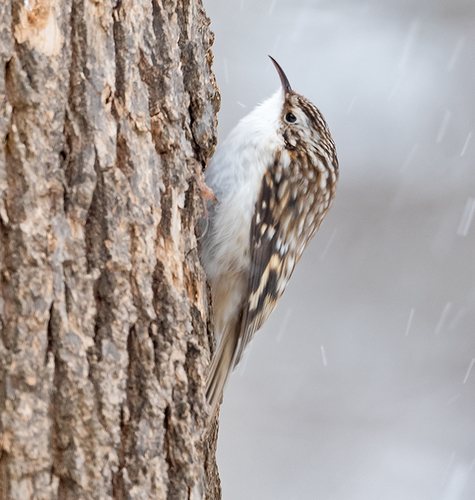
Brown Creeper
Certhia americana
A master of disguise, the Brown Creeper is the only North American bird that hitches its way up tree trunks like a tiny, feathered mountaineer. With its bark-like plumage and curved bill, it turns every tree into a hidden hunting ground.
Quick Identification
Size
Length: 12-14 cm (4.7-5.5 in); Wingspan: 17-20 cm (6.7-7.9 in); Weight: 5-10 g (0.18-0.35 oz)
Colors
Streaked brown, buff, and black upperparts; white or pale cream underparts; brownish-red tail; whitish stripe over the eye.
Key Features
- Slender, downward-curved (decurved) bill
- Long, stiff tail feathers used for propping against bark
- Distinctive 'spiral' climbing pattern up tree trunks
- Highly effective bark-mimicking camouflage
When You’ll See Them
Geographic range
Where Does the Brown Creeper Live?
Native to the North American continent, the Brown Creeper occupies a vast territory stretching from the boreal forests of Alaska and Canada down through the United States and into the high-altitude mountains of Mexico and Central America. While populations in the northernmost regions and the Rockies are often migratory, moving south or to lower elevations for the winter, many coastal and southern populations remain year-round residents. They are most widely distributed across the lower 48 United States during the winter months when northern birds move into suburban gardens and deciduous woods.
Basemap © OpenStreetMap contributors
Behavior
The Brown Creeper is a master of niche foraging, possessing a unique 'start-at-the-bottom' strategy. It typically lands at the base of a large tree and hitches its way upward in a spiral pattern, probing bark crevices with its thin bill for hidden insects. Once it reaches the high branches, it doesn't climb back down; instead, it drops like a falling leaf to the base of a nearby tree to begin the process again.
These birds are generally solitary or found in pairs, though they frequently join mixed-species foraging flocks during the winter alongside chickadees and kinglets. Because they are tiny and blend perfectly with bark, they are often detected by their thin, high-pitched 'tsee' calls before they are actually seen. Their nesting habit is equally unique—they are the only North American birds that typically build their nests in the hammock-like space between a dead tree's trunk and a loose flap of its peeling bark.
EverydayEarth exclusive
Camera Tips
To capture the Brown Creeper on camera, you must think vertically. Standard birdfeeder placements rarely work because these birds almost never land on perches or the ground. Instead, mount your camera directly onto the trunk of a large, mature tree—ideally one with deeply furrowed bark like an Oak, Pine, or Hickory. Position the camera about 4 to 5 feet off the ground, angled slightly upward to catch them as they begin their ascent.
While they don't visit traditional seed trays, you can lure them into your camera's field of view using 'bark butter' or high-energy suet. Smear a small amount of suet directly into the deep ridges of the bark within the camera's focal range. This mimics their natural foraging behavior and encourages them to linger in front of the lens. Avoid using bright white suet blocks, which can overexpose in the sun and ruin the shot; a brownish suet blend blends better and looks more natural in captures.
Because Brown Creepers are small and move in quick, hitching motions, set your AI camera to its highest sensitivity and use a fast shutter speed or high-frame-rate video setting. They are easily missed by slow sensors. If your camera allows for 'Pre-Roll' recording, enable it, as they often land suddenly and start climbing immediately. The best lighting occurs in the mid-morning when the sun hits the side of the trunk at an angle, highlighting the texture of both the bark and the bird’s intricate feather patterns.
Similar Species
Species that look similar or are commonly confused with Brown Creeper.
Frequently Asked Questions
Record Brown Creeper at your habitat
Connect a camera to start building your own species record — AI identifies every visitor automatically.