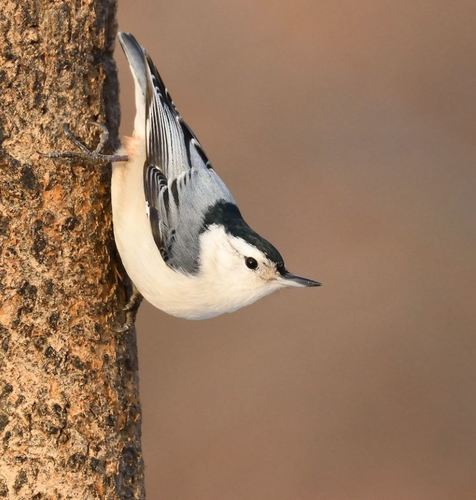
White-breasted Nuthatch
Sitta carolinensis
The acrobat of the backyard, the White-breasted Nuthatch is famous for its head-first descent down tree trunks. With its sharp 'yank-yank' call and industrious personality, it is a favorite for birdwatchers and camera enthusiasts alike.
Quick Identification
Size
Length: 5.1–5.9 in (13–15 cm); Wingspan: 7.9–10.6 in (20–27 cm); Weight: 0.6–1.1 oz (18–30 g)
Colors
Upperparts are a soft blue-gray; face and underparts are bright white. Males have a distinct jet-black crown, while females have a more subdued lead-gray crown. Look for a splash of chestnut coloring on the lower belly and under the tail.
Key Features
- Strong, slightly upturned chisel-like bill
- Black or dark gray cap contrasting against a stark white face
- No neck appearance with a compact, stocky body
- Propensity for moving head-first down tree trunks
When You’ll See Them
Sightings on EverydayEarth
Mar 14, 2026
A White-breasted Nuthatch is perched on the edge of the seed tray, observing its surroundings before flying away from the feeder.
Jun 27, 2026
A White-breasted Nuthatch lands on the feeder tray and hops around, inspecting the seeds. It eventually selects a piece of food and flies away.
Apr 30, 2026
A White-breasted Nuthatch lands on the feeder tray, probes through the sunflower seeds, and flies away with a seed. It briefly returns for a second visit before departing again.
Jul 7, 2026
A White-breasted Nuthatch lands directly on the white feeder tray. It hops around, looking upward and toward the camera, displaying its distinctive facial markings and long bill before moving toward the edge of the tray.
Jul 2, 2026
A White-breasted Nuthatch lands on the white feeder tray and hops about, inspecting the surface for seeds. It gets very close to the lens, providing a detailed view of its long bill and facial markings before it continues to forage on the tray.
Jun 29, 2026
A White-breasted Nuthatch lands on the feeder tray and briefly investigates for food. It turns to look directly at the camera before hopping to the side and flying away.
Behavior
The White-breasted Nuthatch is often called the 'upside-down bird' because of its unique ability to hop down tree trunks head-first. Unlike woodpeckers, which use their stiff tail feathers for balance, the nuthatch relies entirely on its strong feet and long claws to grip the bark. This perspective allows them to find insects hidden in bark crevices that other birds, moving upward, might miss.
These birds are remarkably industrious and get their name from their habit of wedging large seeds or nuts into bark furrows and 'hatching' them—pounding them with their bills until they crack open. They are monogamous and highly territorial; pairs often stay together in the same territory year-round, defending their food sources from intruders. In the winter, they often join 'foraging guilds' with chickadees and titmice for extra protection against predators.
EverydayEarth exclusive
Camera Tips
To capture the best footage of a White-breasted Nuthatch, mount your camera directly onto the trunk of a mature oak, maple, or hickory tree at a height of 5 to 6 feet. Because these birds spend most of their time on vertical surfaces, a trunk-mounted camera provides a much more intimate view than a standard feeder mount. Angle the camera slightly downward, as nuthatches will almost always approach from above, creeping down the trunk toward your target zone.
The secret to attracting them to a specific 'photo spot' is to use their caching behavior to your advantage. Smear a small amount of bark-colored suet or peanut butter directly into the deep ridges of the bark within the camera's frame. Unlike a hanging feeder where they may grab and go in a split second, they will linger on the bark to pry the food out, giving your camera’s motion sensor plenty of time to trigger and capture high-quality images.
Because nuthatches are fast and jittery, use a camera with a fast trigger speed (0.3 seconds or less) and set it to a 'Burst' or 'Photo + Video' mode. They often perform a 'wing-spreading' display to ward off other birds, which makes for spectacular photography. If you are using a feeder, choose a suet cage or a platform feeder rather than a tube feeder, as their physical structure is better suited for flat or vertical surfaces.
Lighting is crucial for this species because of their high-contrast white faces. Try to position the camera facing North or South to avoid the harsh backlighting of the rising or setting sun, which can wash out the detail on their white cheeks. During the winter, place a camera near a heated birdbath; nuthatches are regular drinkers and seeing them interact with water provides a rare break from their usual bark-climbing behavior.
Similar Species
Species that look similar or are commonly confused with White-breasted Nuthatch.
Red-breasted Nuthatch
Smaller with a prominent black eye-stripe and a reddish-cinnamon belly.
Brown-headed Nuthatch
Found in the Southeast US; smaller with a brown cap and a distinct white spot on the nape.
Black-capped Chickadee
Often seen with nuthatches, but has a black bib/throat and hops on branches rather than climbing down trunks.
Frequently Asked Questions
Record White-breasted Nuthatch at your habitat
Connect a camera to start building your own species record — AI identifies every visitor automatically.