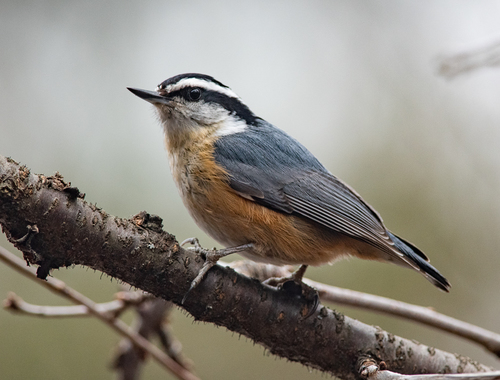
Red-breasted Nuthatch
Sitta canadensis
The Red-breasted Nuthatch is a pocket-sized acrobat of the forest, famous for its gravity-defying ability to walk head-first down tree trunks. With its bold eye stripe and cheerful 'tin trumpet' call, this energetic visitor is a highlight for any backyard birdwatcher.
Quick Identification
Size
Length: 4.3 in (11 cm) | Wingspan: 7.1–8.3 in (18–21 cm) | Weight: 0.3–0.5 oz (8–13 g)
Colors
Blue-grey back and wings, rich cinnamon-orange underparts, white throat, and a distinct black eye stripe sandwiched between a white eyebrow and black crown. Females have duller lead-grey crowns and paler underparts.
Key Features
- Distinctive black eye stripe with a white stripe above it
- Rich cinnamon-colored underparts
- Stout, straight bill used for prying bark
- Acrobatic movement, often seen climbing down tree trunks head-first
When You’ll See Them
Sightings on EverydayEarth
May 27, 2026
A Red-breasted Nuthatch is busy at the feeder tray, hopping between seeds and inspecting them. Its vibrant orange belly and distinct head stripes are clearly visible as it forages in the low evening light.
May 6, 2026
A Red-breasted Nuthatch lands on the edge of the feeder tray, selects a seed, and quickly flies away. The sunny backyard scene shows a lush green lawn and several other feeders in the background.
Apr 17, 2026
A Red-breasted Nuthatch is perched on the edge of the feeder tray for a brief moment. Its colorful plumage is visible before it quickly takes flight and leaves the area.
Apr 17, 2026
A Red-breasted Nuthatch is perched on the rim of the white feeder tray. It pauses for a moment to look around before taking flight and departing the scene to the left.
Apr 17, 2026
A Red-breasted Nuthatch lands on the rim of the feeder tray, displaying its distinctive black-and-white head pattern and rusty belly. It pauses for a second to observe its surroundings before hopping off and flying away.
Apr 17, 2026
A Red-breasted Nuthatch lands on the seed tray on a misty, rainy morning. It moves with characteristic jerky motions, searching for a specific seed before flying away.
Behavior
The Red-breasted Nuthatch is a tiny, energetic bird known for its remarkable agility and its constant, nasal "yank-yank" call, which sounds much like a miniature tin trumpet. Unlike most birds that hop or fly from branch to branch, nuthatches are specialists at navigating the vertical world of tree trunks. They are famous for their ability to descend trees head-first, a perspective that allows them to find insects hiding in bark crevices that upward-climbing birds like woodpeckers might miss.
These birds are highly social during the non-breeding season and often join mixed foraging flocks with chickadees and kinglets. They are also remarkably bold around humans; if you are patient and offer seeds, they are one of the few backyard species that may eventually learn to eat right out of your hand. In the winter, they are industrious hiders, frequently tucking seeds into bark furrows to save for a leaner day.
EverydayEarth exclusive
Camera Tips
To capture the best footage of a Red-breasted Nuthatch, you need to think vertically. While most backyard cameras are aimed at flat feeding trays, nuthatches prefer to approach from the side or from above. Mounting your AI-powered camera directly onto the trunk of a large conifer or oak tree, about 5-6 feet off the ground, provides an intimate look at their unique head-down climbing style. Aim the lens at a specific patch of bark where you have wedged some suet or smeared a little nut butter to encourage them to linger in the frame.
Because these birds are incredibly fast and rarely sit still, trigger speed is everything. Set your camera to its fastest possible shutter speed or use a high-frame-rate video setting (at least 60fps) to avoid motion blur. If your camera supports a "Pre-Record" or "Burst" mode, enable it; nuthatches often fly in, grab a single seed, and vanish in under three seconds. A camera with a short focal distance is ideal, as these birds will often hop right up to the lens to investigate their own reflection.
Placement near a suet cage or a tube feeder is a winning strategy. To get the most iconic "nuthatch pose," place a suet feeder on the side of a tree and position the camera 2-3 feet away, angled slightly upward. During the winter, they are much more focused on high-fat foods, making this the best time to set up your gear. If you are using an AI camera with animal detection, ensure it is set to a high sensitivity, as their small size and rapid movements can sometimes be missed by standard motion sensors.
Similar Species
Species that look similar or are commonly confused with Red-breasted Nuthatch.
White-breasted Nuthatch
Larger with a clean white face and no black eye stripe; prefers deciduous trees.
Brown-headed Nuthatch
Limited to the Southeastern US, it has a brown cap and lacks the black eye stripe.
Pygmy Nuthatch
Found in the West, it is smaller with a brownish-grey cap and lacks the bold black eye stripe.
Frequently Asked Questions
Record Red-breasted Nuthatch at your habitat
Connect a camera to start building your own species record — AI identifies every visitor automatically.