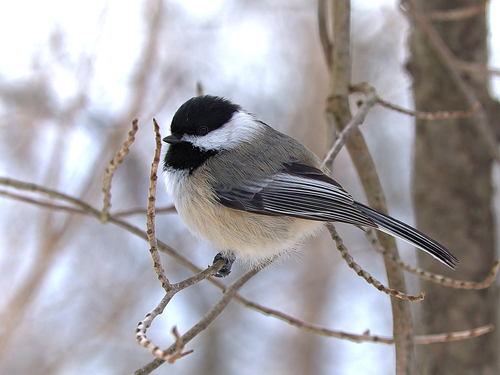
Black-capped Chickadee
Poecile atricapillus
With its cheery 'chick-a-dee' call and bold personality, the Black-capped Chickadee is the ultimate backyard companion. This tiny but tough bird is a master of survival and a favorite for wildlife watchers across North America.
Quick Identification
Size
Length: 12-15 cm (4.7-5.9 in); Wingspan: 16-21 cm (6.3-8.3 in); Weight: 9-14 g (0.3-0.5 oz)
Colors
Solid black cap and throat bib contrasting with bright white cheeks. Soft grey wings and back, with a white belly and distinct tan/buffy coloration on the sides (flanks). Males and females look identical.
Key Features
- Jet-black cap and bib with snow-white cheeks
- Short, stubby black bill
- Pale buff-colored sides and grey upperparts
- Hyperactive, acrobatic movement on branches
When You’ll See Them
Sightings on EverydayEarth
Apr 1, 2026
A Pine Siskin perches on the edge of the copper bird bath, surveying the area. A second Pine Siskin briefly flutters into the frame from the bottom left, showing the characteristic yellow patches on its wings. In the background, a Black-capped Chickadee is active at a hanging tube feeder attached to the pine tree.
Mar 14, 2026
A Black-capped Chickadee lands on the feeder tray, hops around while foraging, and then departs.
Aug 2, 2026
An active early morning at the feeders. A male Downy Woodpecker is perched on the suet log to the left, while a Mourning Dove feeds on the tray below. In the background, a Black-capped Chickadee flits onto a tube feeder to grab a seed.
Jul 13, 2026
A very active morning at the feeders with several species feeding simultaneously. A Hairy Woodpecker and Black-capped Chickadee utilize the suet feeders on the left. In the center, a European Starling and a Brown-headed Cowbird feed from the tray, while a Blue Jay perches briefly on the central post. On the right, a group of Common Grackles is joined by a male Red-winged Blackbird on the tube feeder.
Jul 9, 2026
A Black-capped Chickadee lands on the edge of the feeder tray, pauses to look at the seeds, and then quickly hops away.
Jul 9, 2026
A Black-capped Chickadee is perched inside the feeder tray, actively sifting through a mix of sunflower seeds and corn. It hops around, tossing seeds aside as it searches for a specific piece before pausing to look around the yard.
Geographic range
Where Does the Black-capped Chickadee Live?
This resilient little bird is a native staple of North America, spanning the continent from coast to coast. Its core territory includes the majority of Canada and the northern half of the United States, stretching as far south as the Appalachian Mountains and the northern parts of New Mexico. While it is a permanent resident throughout its range, it is primarily found in temperate forests and suburban landscapes where mature trees are plentiful and nesting cavities are available.
Basemap © OpenStreetMap contributors
Recorded on EverydayEarth
Behavior
In terms of communication, they possess one of the most sophisticated vocal systems in the bird world. Their namesake 'chick-a-dee-dee-dee' call isn't just a label; it’s a warning system. The number of 'dee' notes at the end increases based on the perceived threat level of a predator. Despite their small size, they are incredibly hardy, surviving sub-zero temperatures by entering a state of regulated hypothermia at night to conserve energy.
EverydayEarth exclusive
Camera Tips
To capture the perfect shot of a Black-capped Chickadee, place your camera near a bird feeder or a water source, as these are their primary magnets. They are extremely fast movers, often grabbing a seed and flying away instantly, so use a camera with a high trigger speed (0.2s or faster) and a short reset interval. Position the camera about 4 to 6 feet (1.2 to 1.8 meters) from the target, ideally at eye level with the bird to capture the detail in their black cap and bib.
Baiting is highly effective with these birds. A suet cage or a tube feeder filled with black oil sunflower seeds will keep them coming back. If you want more natural-looking shots, smear a small amount of peanut butter or 'bark butter' into the crevices of a nearby tree limb and aim your camera there. This encourages them to land and linger while they peck at the food, giving your AI camera plenty of time to trigger and record a high-quality video or photo.
Because chickadees are active throughout the day, lighting is usually your friend. However, they are most active in the early morning hours just after sunrise. During winter, they are even more frequent visitors to cameras as they search for high-energy fats. Ensure your camera is set to 'burst mode' if available, as their rapid movements can result in many blurry photos; multiple shots in a sequence increase your chances of getting that crisp, iconic 'perched' look with their feathers fluffed out against the cold.
Similar Species
Species that look similar or are commonly confused with Black-capped Chickadee.
Carolina Chickadee
Very similar but found further south; has less white in the wings and a more complex four-note song.
Mountain Chickadee
Distinguished by a prominent white 'eyebrow' stripe above the eye that breaks up the black cap.
Tufted Titmouse
A close relative that is larger, entirely grey with a distinct pointed crest on its head.
Frequently Asked Questions
Record Black-capped Chickadee at your habitat
Connect a camera to start building your own species record — AI identifies every visitor automatically.