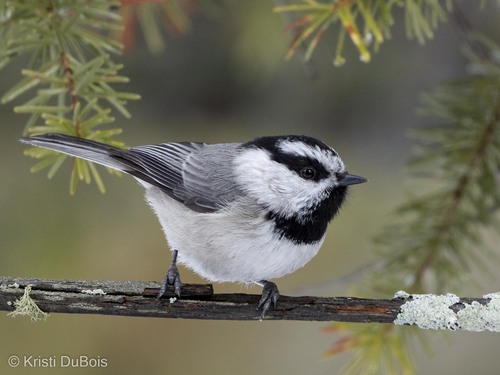
Mountain Chickadee
Poecile gambeli
The Mountain Chickadee is the high-altitude acrobat of the West, easily identified by the striking white 'racing stripe' across its eyes. A master of memory, this tiny bird can remember the location of thousands of hidden seeds to survive the harshest alpine winters.
Quick Identification
Size
Length: 5–6 in (13–15 cm); Wingspan: 7.5 in (19 cm); Weight: 0.3–0.4 oz (9–12 g)
Colors
A black cap and throat bib, gray upperparts, and pale gray-to-white underparts. Both sexes look identical.
Key Features
- Distinctive white line (eyebrow) above the eye
- Black cap and black throat bib
- Short, stout black bill
- Pale gray flanks and white cheeks
When You’ll See Them
Geographic range
Where Does the Mountain Chickadee Live?
Native to the rugged landscapes of western North America, the Mountain Chickadee is a quintessential bird of the high peaks. Its range stretches from the southern reaches of the Yukon in Canada down through the Rocky Mountain corridor and the Sierra Nevada, reaching as far south as the mountains of Baja California in Mexico. Unlike many other songbirds, they are largely non-migratory, remaining in their mountain territories year-round, though some populations may move to slightly lower elevations during particularly harsh winters.
Basemap © OpenStreetMap contributors
Behavior
Mountain Chickadees are the spirited acrobats of high-altitude coniferous forests. Known for their energetic nature, they are often seen hanging upside down from pine cones or balancing on the thinnest of twigs to reach hidden seeds and insects. They are highly social birds, frequently acting as the leaders of mixed-species foraging flocks during the winter months, traveling alongside nuthatches, kinglets, and creepers.
One of their most remarkable behaviors is their incredible spatial memory. During the late summer and fall, a single bird will cache thousands of seeds in individual locations across its territory. Their brains actually enlarge during the winter to help them remember these locations, a vital adaptation for surviving deep mountain snows. Around humans, they are famously bold and curious, often being the first birds to investigate a newly placed feeder or even landing on the hands of patient hikers.
EverydayEarth exclusive
Camera Tips
To capture high-quality footage of Mountain Chickadees, positioning is everything. Place your AI-powered camera approximately 5 to 6 feet off the ground, aiming at a specific 'landing branch' near a feeder rather than the feeder itself. This captures the bird in a more natural pose before it darts in for a seed. Because these birds are incredibly fast, set your camera to its highest possible frame rate—at least 30fps, though 60fps is ideal—to avoid blurred motion and to catch the detail in their rapid wing beats.
Baiting with high-energy fats is the most effective way to keep them in the camera's field of view for more than a split second. Use a suet plug or smear peanut butter into the crevices of a natural log to encourage 'probing' behavior, which makes for much more engaging video than a bird simply grabbing a seed from a tray. In winter, they are particularly attracted to heated birdbaths; a water source in a frozen environment is a magnet for these birds and provides a perfect stage for capturing bathing and drinking behaviors.
Pay attention to lighting and camera settings. Because Mountain Chickadees are often found in dark, evergreen canopies, ensure your camera is positioned to receive ample morning light, which is when they are most active. If your camera allows for focal range adjustments, set it for a narrow field of view (macro or close-up) roughly 2-4 feet from the lens. This will highlight the distinctive white 'eyebrow' stripe that separates them from other chickadee species, providing that professional-level wildlife photography look from your own backyard.
Similar Species
Species that look similar or are commonly confused with Mountain Chickadee.
Black-capped Chickadee
Lacks the white eyebrow stripe and has more buffy/yellowish color on the sides (flanks).
Juniper Titmouse
Entirely gray without a black cap or bib, and possesses a small, pointed crest on its head.
Chestnut-backed Chickadee
Has a distinct reddish-brown (chestnut) back and flanks, and also lacks the white eyebrow stripe.
Frequently Asked Questions
Record Mountain Chickadee at your habitat
Connect a camera to start building your own species record — AI identifies every visitor automatically.