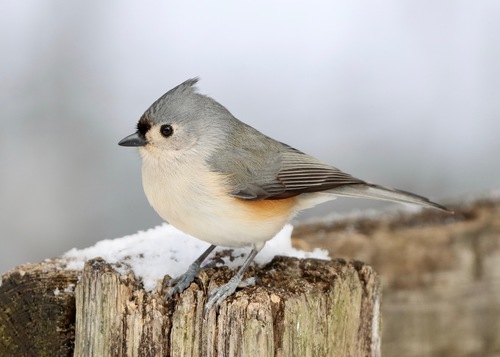
Tufted Titmouse
Baeolophus bicolor
Bold, crested, and full of personality, the Tufted Titmouse is the backyard acrobat that every birdwatcher loves. With its echoing whistle and curious nature, it brings a spark of life to the forest canopy and garden feeders alike.
Quick Identification
Size
Length: 5.5-6.3 in (14-16 cm) | Wingspan: 7.9-10.2 in (20-26 cm) | Weight: 0.6-0.9 oz (18-26 g)
Colors
Soft silvery-grey upperparts with white underparts and distinctive rusty or peach-colored flanks. They feature a prominent grey crest and a small black patch on the forehead just above the beak. Males and females are identical in appearance.
Key Features
- Prominent pointed grey crest
- Large, dark, soulful eyes
- Rusty or peach-colored wash along the flanks
- Small black square above the bill
- Stout, short beak
When You’ll See Them
Sightings on EverydayEarth
Jul 29, 2026
During a light rain, a male Hairy Woodpecker clings to the central feeder post, working on a block of suet. On the left, a Tufted Titmouse briefly visits the hanging feeders, while a male Red-winged Blackbird arrives at the tube feeder on the right toward the end of the sequence.
Jul 29, 2026
A Northern Cardinal is perched on the suet feeder, actively feeding on the block. Shortly after, a Tufted Titmouse lands on the large wooden feeder tray, looking around cautiously before hopping across the platform.
Jul 29, 2026
During a steady rain shower, a Tufted Titmouse hops across the main feeder tray. Meanwhile, two Brown-headed Cowbirds land on the hanging tube feeder to the right to feed. A male Red-winged Blackbird briefly flashes into view on the left as it flies past the station.
Jul 25, 2026
A Tufted Titmouse lands on the right edge of the wooden tray feeder. It quickly hops into the tray, looks around for a moment, and then flies out of the frame.
Jul 19, 2026
A bustling mid-day scene at the feeding station with high species diversity. Two Mourning Doves and a male Red-winged Blackbird are feeding on the tray when a male Northern Cardinal briefly lands. A Common Grackle later arrives on the tray, while a Blue Jay lands on the peanut feeder to the right. Downy Woodpeckers are visible on both the suet and peanut feeders, and a Tufted Titmouse perches briefly on the central post.
Jun 23, 2026
An active morning at the feeder station with several species visiting simultaneously. A Mourning Dove and an American Robin feed together in the main tray, while a Common Grackle and a Tufted Titmouse take turns at the hanging tube feeders to the right.
Behavior
The Tufted Titmouse is a high-energy acrobat, often seen hanging upside down from branches while foraging for insects or seeds. They are highly social birds and are frequently found leading 'mixed flocks' during the winter months, accompanied by chickadees, nuthatches, and woodpeckers. Their presence is often announced by a loud, clear 'peter-peter-peter' whistle that carries through the woods, making them one of the more vocal residents of the canopy.
Unlike many birds that eat their seeds where they find them, the titmouse is a 'hoarder.' You will often see one grab a single sunflower seed from a feeder and immediately fly to a nearby branch. There, it holds the seed between its feet and uses its strong beak like a tiny hammer to crack it open. They are bold and curious birds, often being the first to investigate a new feeder or a strange sound in the garden, and they have even been known to pluck hair from living mammals—including humans—to line their nests.
EverydayEarth exclusive
Camera Tips
To capture the best footage of a Tufted Titmouse, place your AI-powered camera within 3 to 5 feet of a bird feeder, ideally at eye level (about 5 feet off the ground). Because these birds are incredibly fast and rarely sit still for more than a few seconds, a camera with a high frame rate and a fast trigger speed is essential to avoid blurry shots. Position the camera so it faces away from the direct sun to avoid silhouette effects, as their soft grey plumage can easily look washed out or lose detail in harsh backlighting.
Baiting is the most effective way to lure this species into your camera's view. They are particularly attracted to black-oil sunflower seeds, shelled peanuts, and high-quality suet. During the winter, a suet cage placed directly in the camera's field of view can provide longer video clips, as the bird has to spend more time pecking at the fat than it would simply grabbing a seed and flying away. In the summer months, a birdbath with a 'wiggler' or dripping water feature is an irresistible lure, often resulting in charming footage of the titmouse splashing and grooming its crest.
Pay close attention to the framing of your shot. Since the Tufted Titmouse is primarily grey and white, a background of vibrant green foliage or textured dark bark will help the bird stand out in your captures. If you are using a trail camera in a more natural setting rather than a backyard feeder, look for 'snags' (dead standing trees) with small natural cavities; titmice often nest or roost in these and will provide excellent activity near the entrance. Adjust your camera's PIR sensitivity to 'High' to ensure the sensor catches these small, light-weight birds as they dart in and out of the frame.
Similar Species
Species that look similar or are commonly confused with Tufted Titmouse.
Black-crested Titmouse
Almost identical in shape, but features a black crest and a white forehead; it is primarily found in Texas and Mexico.
Black-capped Chickadee
A close relative often found in the same flocks, but lacks a crest and features a distinctive black cap and bib.
Juniper Titmouse
A plain grey western relative that lacks the black forehead patch and the rusty flanks of the Tufted Titmouse.
Frequently Asked Questions
Record Tufted Titmouse at your habitat
Connect a camera to start building your own species record — AI identifies every visitor automatically.