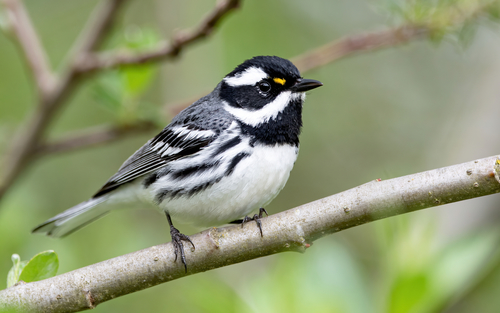
Black-throated Gray Warbler
Setophaga nigrescens
A dapper visitor of the Western woods, the Black-throated Gray Warbler is a study in monochrome elegance with its crisp tuxedo-like plumage and a tiny splash of yellow. Discover how to spot this canopy-dwelling gem in your own backyard.
Quick Identification
Size
Length: 12-13 cm (4.7-5.1 in); Wingspan: 19-20 cm (7.5-7.9 in); Weight: 8.4-10 g (0.3-0.4 oz)
Colors
A crisp palette of charcoal gray, white, and black. Males feature a solid black throat and crown with white 'eyebrow' and 'mustache' stripes. Females have a white throat and more muted gray-black tones. Both sexes have a tiny, bright yellow spot in front of the eye.
Key Features
- Bold black and white striped head pattern
- Distinctive tiny yellow spot (supraloral) between the eye and bill
- Clean white underparts with black streaks on the flanks
- Two white wing bars on dark gray wings
When You’ll See Them
Geographic range
Where Does the Black-throated Gray Warbler Live?
The Black-throated Gray Warbler is a quintessential bird of the North American West. Its breeding range extends from the coastal forests of British Columbia southward through the mountainous regions of the United States, including the Cascades, Sierras, and Rockies, down into New Mexico and Arizona. When the weather turns cold, these birds migrate to their wintering grounds in Mexico and the southern tips of the Southwestern United States, making them a common sight along the Pacific Flyway during spring and autumn.
Basemap © OpenStreetMap contributors
Behavior
The Black-throated Gray Warbler is an active and methodical forager, typically found hopping through the middle and upper layers of the canopy. Unlike some of its more erratic cousins, it moves with a deliberate pace, carefully gleaning insects from the undersides of leaves and the crevices of bark. While they are energetic, they often stay within the cover of foliage, making them a rewarding challenge for backyard observers to spot.
During the breeding season, males are highly vocal, singing a dry, buzzy song that consists of several rising notes followed by a downward finish. They are largely solitary outside of the breeding season but can occasionally be found in mixed-species foraging flocks during migration. They are not particularly shy around humans but rarely descend to the ground, preferring the safety of high branches.
EverydayEarth exclusive
Camera Tips
To capture the Black-throated Gray Warbler on a backyard camera, you must think vertically. These birds rarely visit ground-level feeders. Instead, mount your camera 6 to 12 feet high in a tree, ideally an oak or pinyon pine. Angling the camera slightly downward toward a horizontal branch that offers a clear 'landing strip' near the outer edge of the canopy will increase your chances of a clear shot.
Water is the best lure for this species. They are highly attracted to the sound of moving water, so a elevated birdbath with a solar-powered fountain or a 'dripper' attachment is incredibly effective. Position your AI camera within 3 to 5 feet of the water source, and ensure the background is slightly shaded to prevent the bird's white plumage from 'blowing out' in bright sunlight. High-speed shutter settings or 'Burst Mode' are essential to freeze their quick movements.
Since they are insect-eaters, they won't visit standard seed feeders. However, maintaining a pesticide-free garden with native western shrubs will attract the caterpillars and spiders they crave. During the peak migration months of April and May, focus your camera activity in the early morning hours when males are most active and likely to descend slightly lower to forage or bathe.
Similar Species
Species that look similar or are commonly confused with Black-throated Gray Warbler.
Black-and-white Warbler
Lacks the yellow eye spot and has a striped back; crawls along tree trunks rather than hopping through small branches.
Blackpoll Warbler
Has orange-yellow legs and lacks the distinct yellow supraloral spot; breeding males have a solid black cap without the white eyebrow stripe.
Townsend's Warbler
Shares a similar facial pattern but features vibrant yellow on the breast and face where the Black-throated Gray is white.
Frequently Asked Questions
Record Black-throated Gray Warbler at your habitat
Connect a camera to start building your own species record — AI identifies every visitor automatically.