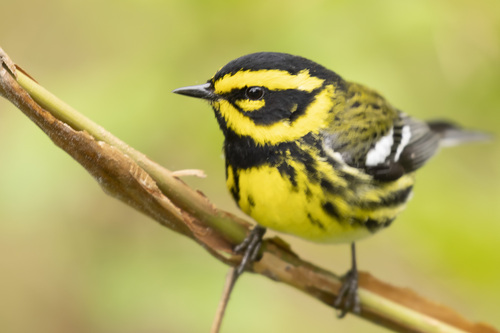
Townsend's Warbler
Setophaga townsendi
A flash of gold in the evergreen shadows, the Townsend's Warbler is a master of the high canopy. With its striking black mask and tireless energy, this tiny traveler is a favorite visitor for backyard birders across the West.
Quick Identification
Size
Length: 4.7–5 in (12–13 cm); Wingspan: 7.5–8 in (19–20 cm); Weight: 0.2–0.4 oz (7–11 g)
Colors
Bright yellow face with a contrasting black cheek patch and crown; males have a black throat, while females/immatures have a yellow throat; olive-green back with dark streaks and two white wing bars.
Key Features
- Bold black mask or ear patch on a vibrant yellow face
- Vivid yellow breast with black streaks along the flanks
- Two distinct white wing bars on grey-black wings
- Olive-green back with subtle dark streaking
When You’ll See Them
Behavior
Townsend's Warblers are the restless acrobats of the evergreen canopy. They are most frequently observed darting through the outer branches of conifers, where they perform impressive aerial maneuvers to snatch insects mid-air or hover momentarily to glean larvae from the underside of needles. During the winter months, they often join "winter parties"—mixed species flocks of chickadees, kinglets, and nuthatches—relying on the group for protection and locating food sources.
While they are primarily high-dwellers, these warblers become surprisingly approachable in backyard settings, especially along the Pacific Coast during winter. They are one of the few warbler species that show a genuine interest in bird feeders, often appearing quite bold as they compete with larger birds for a spot at a suet block. Their presence is usually announced by a thin, buzzy song or a sharp 'tsick' call note that echoes through the trees.
EverydayEarth exclusive
Camera Tips
Capturing a Townsend's Warbler on camera requires a strategy focused on their favorite backyard pit stops: water and high-energy fats. Unlike many shy forest birds, these warblers are drawn to the sound of moving water. For the best shots, position your camera 3 to 5 feet away from a birdbath that features a solar-powered dripper or mister. Set the camera at eye level with the water's surface to capture the stunning reflection of their yellow face as they dip down to drink.
Because these birds are incredibly fast and rarely sit still for more than a second, your camera's trigger speed is critical. Use a 'Burst Mode' or 'High-Speed' setting if available to capture the frame where their wings are fully extended or their head is turned to show the mask. If you are using a triggered trail camera, set the PIR sensitivity to 'High' and the interval to '0 seconds' to ensure you don't miss the action when they zip in and out of the frame.
In the winter, you can lure them directly to a specific spot using suet or a specialized hummingbird feeder. Townsend's Warblers have a documented sweet tooth; placing a camera near a nectar feeder in the early morning can yield spectacular results. Mount your camera on a nearby branch or a dedicated tripod rather than the feeder itself to avoid the camera shaking every time a bird lands. Aim for a 'bokeh' effect by ensuring there is significant distance between the feeder and the background foliage, which makes the bird’s vibrant colors pop.
Lighting is your best friend when dealing with such high-contrast markings. Try to position your camera so the sun is behind you, illuminating the bird’s face. In the deep shade of coniferous trees, Townsend's Warblers can appear as dark silhouettes; using a camera with a good low-light sensor or a gentle, non-startling infrared flash for early morning captures can help reveal the intricate black streaking on their yellow flanks.
Similar Species
Species that look similar or are commonly confused with Townsend's Warbler.
Hermit Warbler
Lacks the black ear patch of the Townsend's, featuring a completely clear yellow head and a white belly.
Black-throated Green Warbler
Very similar but found primarily in the East; it lacks the dark 'mask' through the eye, having a more open yellow face.
Blackburnian Warbler
Features a brilliant orange throat instead of yellow and has distinct triangular black face markings.
Frequently Asked Questions
Record Townsend's Warbler at your habitat
Connect a camera to start building your own species record — AI identifies every visitor automatically.