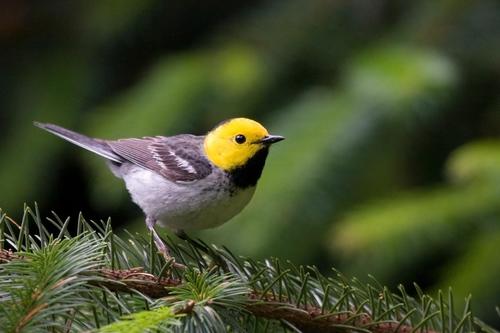
Hermit Warbler
Setophaga occidentalis
A hidden gem of the Pacific evergreens, the Hermit Warbler dazzles with its brilliant yellow face and elusive canopy-dwelling lifestyle. Spotting this migratory wood-warbler is a true badge of honor for any western wildlife enthusiast.
Quick Identification
Size
Length: 12-14 cm (4.7-5.5 in); Wingspan: 20-21 cm (7.9-8.3 in); Weight: 9-11 g (0.3-0.4 oz)
Colors
Brilliant yellow head and face; males feature a solid black throat and bib; olive-gray back with dark streaks; white underparts; two prominent white wing bars
Key Features
- Solid yellow face without dark cheek patches
- Jet black throat bib on males
- Two crisp white wing bars
- High-pitched, buzzing song often ending in a sharp note
When You’ll See Them
Geographic range
Where Does the Hermit Warbler Live?
The Hermit Warbler is a native of the Western North American wilderness, with a primary breeding range that hugs the Pacific Coast from Washington and Oregon down through the mountain ranges of California. As a migratory species, they travel south for the winter, populating the high-altitude pine-oak forests of Mexico and Central America, including Guatemala and Honduras. While they are western specialists, lucky birders occasionally spot them along the southern California coast during their winter residency.
Basemap © OpenStreetMap contributors
Behavior
The Hermit Warbler is a master of the high canopy, often spending its life in the topmost branches of towering conifers. Because of this preference for heights, they are often heard long before they are seen, earning their "hermit" moniker through their elusive nature. They are highly active foragers, frequently seen hovering briefly at the tips of evergreen needles to snatch insects or perform acrobatic maneuvers to glean larvae from the underside of branches.
During the breeding season, males are territorial and sing persistently from high perches to defend their space. While they are generally solitary during the summer, they become more social during migration, often joining mixed-species foraging flocks that include chickadees, nuthatches, and other warblers. Despite their shyness, they are remarkably focused birds, often ignoring human observers if they are busy foraging during a migration stopover.
EverydayEarth exclusive
Camera Tips
Capturing a Hermit Warbler on camera is a challenge because of their canopy-dwelling habits, but water is your secret weapon. Because these birds rarely descend to ground level for food, a bird bath with moving water—like a dripper or a small fountain—is the most effective way to lure them into the frame of a backyard camera. Position your camera at a slight downward angle toward the water source, ideally mounted on a tripod or fence post about 3 to 5 feet away to ensure the AI can trigger on their small, fast movements.
Since these birds are migratory, your best window for success is during the spring (late April and May) and late summer (August). Use high-speed trigger settings and, if possible, set your camera to record short, high-resolution video clips rather than still photos. Their identifying features, such as the yellow face and black throat, are much easier to confirm when you can see the bird moving and foraging from multiple angles. A high shutter speed is essential to prevent motion blur, as warblers are famously twitchy.
Lighting is another crucial factor for these forest-loving birds. Try to place your camera in a spot that receives dappled morning light. The bright yellow face of the Hermit Warbler can easily "blow out" or look overexposed in direct, harsh midday sun, while deep shade might make the black throat bib hard to distinguish from the surrounding shadows. Aim for a spot where the sun hits the water source around 8:00 AM, which is their prime bathing and drinking time before they return to the high branches.
Similar Species
Species that look similar or are commonly confused with Hermit Warbler.
Frequently Asked Questions
Record Hermit Warbler at your habitat
Connect a camera to start building your own species record — AI identifies every visitor automatically.