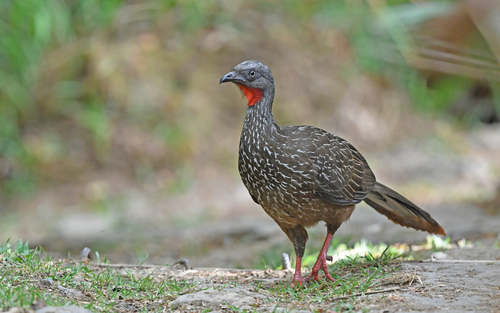
Band-tailed Guan
Penelope argyrotis
A mist-dwelling beauty of the northern Andes, the Band-tailed Guan is easily recognized by its silvery plumage and iconic white-tipped tail. These vocal residents are a prized sight for any observer in the South American cloud forests.
Quick Identification
Size
50-65 cm (20-26 inches) in length; weighs approximately 600-900g (1.3-2 lbs)
Colors
Dull brownish-olive body with prominent silvery-white edging on the feathers of the head, neck, and upper breast; bright red throat dewlap
Key Features
- Distinctive whitish band at the tip of the tail
- Silvery-white scaling on the head and neck
- Bright red fleshy throat dewlap
- Stocky, turkey-like build with a long tail
When You’ll See Them
Geographic range
Where Does the Band-tailed Guan Live?
Native to the northern reaches of South America, the Band-tailed Guan is found specifically in the montane regions of Colombia and Venezuela. Its range encompasses the northern Andes, the Sierra Nevada de Santa Marta, and the Coastal Cordillera, where it favors the lush, mist-heavy slopes of high-altitude forests. It is a sedentary species, remaining in its mountain territory throughout the year.
Basemap © OpenStreetMap contributors
Behavior
The Band-tailed Guan is a social and somewhat shy resident of the forest canopy, though it is frequently seen in pairs or small family groups. While they spend much of their time moving through the middle and upper layers of the forest, they are known to descend to the ground to forage for fallen fruit or to visit water sources. They are particularly famous for their loud, raucous vocalizations, which consist of harsh, barking calls that are most frequently heard during the early morning hours.
These birds are remarkably agile for their size, leaping between branches with ease. During the breeding season, they perform a unique wing-drumming display—a mechanical sound produced by rapidly beating their wings during a short flight between trees. Despite being somewhat wary of humans in remote areas, they can become quite habituated to gardens and coffee plantations that provide adequate cover and food.
EverydayEarth exclusive
Camera Tips
To successfully capture the Band-tailed Guan on your camera, focus on 'ecotones'—the transition zones where dense cloud forest meets more open garden clearings or trails. These birds are creatures of habit and often follow specific aerial pathways through the canopy or hop along the ground to reach reliable food sources. Mount your camera between 3 and 5 feet off the ground, slightly angled upward if you are placing it near the base of a known fruiting tree like a Ficus or a member of the laurel family.
While they are primarily arboreal, Band-tailed Guans frequently descend to the forest floor to scavenge for fallen fruit or to drink. Placing a camera near a shallow forest pool or a large stone birdbath can yield excellent results, especially during the drier months. If you want to attract them to a specific spot, a small pile of overripe tropical fruits like bananas or papayas at the base of a tree can serve as an effective lure. Position the camera at a distance of at least 8 feet to ensure the entire bird and its long tail stay within the frame, as close-up shots often cut off their most identifying features.
Because these birds are most active during the low-light hours of dawn and dusk, ensure your camera has a high-quality infrared sensor and a fast trigger speed to avoid blurred images. They are often most vocal and mobile between 6:00 AM and 9:00 AM. In your settings, opt for a multi-shot burst mode (3-5 photos) or short video clips of 15-20 seconds. Guans often exhibit interesting social behaviors, such as tail-fanning or mutual grooming, which are much better captured in motion than in a single still photograph.
Similar Species
Species that look similar or are commonly confused with Band-tailed Guan.
Frequently Asked Questions
Record Band-tailed Guan at your habitat
Connect a camera to start building your own species record — AI identifies every visitor automatically.