Andean Guan
Penelope montagnii
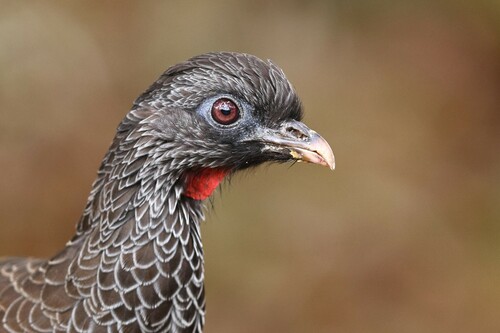
Meet the 'chicken of the cloud forest,' an agile climber with a vibrant red throat that thrives in the misty heights of the Andes Mountains.
Quick Identification
Size
40–58 cm (16–23 in) in length; 600–1,100 g (1.3–2.4 lbs) in weight
Colors
Dark brownish-bronze plumage with silvery-grey scaling on head and neck; bright red throat dewlap and reddish legs
Key Features
- Prominent bare red throat skin (dewlap)
- Distinct silvery-white feather edges on head and neck
- Long, rounded tail used for balance
- Reddish-pink legs and feet
When You’ll See Them
Geographic range
Where Does the Andean Guan Live?
The Andean Guan is a native of the South American continent, found exclusively along the high-altitude spine of the Andes Mountains. Its core range begins in the coastal cordilleras of Venezuela and extends through all three Andean ranges in Colombia, continuing southward through the humid highlands of Ecuador and Peru. It reaches its southern limit in the cloud forests of Bolivia, with occasional sightings reported in the extreme northwestern fringes of Argentina.
Basemap © OpenStreetMap contributors
Behavior
The Andean Guan is a primarily arboreal bird, often seen navigating the misty canopy of cloud forests with surprising agility. While they can appear somewhat clumsy on the ground, they are expert climbers, using their strong legs and long tails for balance as they hop between moss-covered branches. They are typically found in pairs or small family groups, maintaining social bonds through soft contact calls and mutual grooming.
In areas where they are not hunted, these birds can become remarkably habituated to human presence, sometimes visiting gardens or lodge clearings. However, they remain vigilant, and when startled, they often emit a loud, nasal honking or cackling sound before gliding away into deeper cover. During the breeding season, males may perform wing-drumming displays, which is a characteristic mechanical sound of the high-altitude Andean forests.
EverydayEarth exclusive
Camera Tips
To capture the Andean Guan, your best bet is to position cameras along forest edges or near known fruiting trees, such as wild avocados or berry-producing shrubs. While these birds are mostly arboreal, they frequently descend to the forest floor or low-hanging branches to drink from puddles or forage for fallen fruit. Mounting your camera about 3 to 5 feet off the ground, angled slightly upward toward a clear perch, often yields the most dramatic "portrait" shots.
Because they live in humid cloud forests, moisture management is critical for your gear. Use a camera with a high waterproof rating and consider placing a small silica gel pack inside the housing to prevent lens fogging during the misty mornings when the birds are most active. If you are setting up in a backyard or garden near the forest, placing the camera near a low-profile platform feeder filled with soft fruits like papaya or bananas can draw them into the perfect frame.
For camera settings, focus on a fast trigger speed. Despite their somewhat bulky size, these birds can be quite jumpy. A trigger speed of 0.3 seconds or faster ensures you don't just get a photo of a disappearing tail. Since the understory of their habitat is often dimly lit, ensure your camera has a high-quality infrared flash that won't blow out the details of their silvery neck feathers, or set the ISO to auto to compensate for the shifting mountain light.
If your camera supports high-definition video, the Andean Guan is an excellent subject for short clips. They have fascinating social behaviors, including mutual preening and unique "clucking" vocalizations. Set your video length to 15-20 seconds to capture these interactions. Look for "game trails" in the moss or flattened areas of leaf litter, which often indicate where these birds regularly travel on the ground.
Similar Species
Species that look similar or are commonly confused with Andean Guan.
Frequently Asked Questions
Record Andean Guan at your habitat
Connect a camera to start building your own species record — AI identifies every visitor automatically.