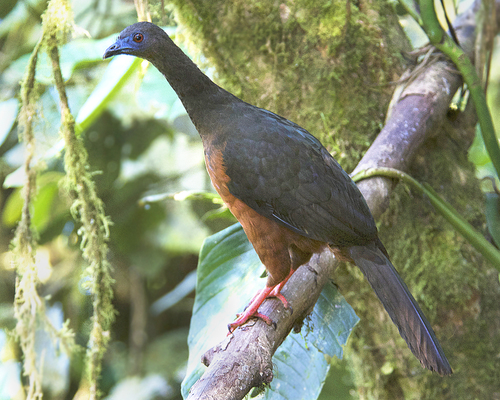
Sickle-winged Guan
Chamaepetes goudotii
A hidden gem of the Andean cloud forests, the Sickle-winged Guan is famous for its vibrant blue face and the unique 'drumming' sound of its wings. This elusive mountain bird brings a touch of prehistoric beauty to high-altitude backyards.
Quick Identification
Size
Length of 50-65 cm (20-26 in); weight between 550-880g (1.2-1.9 lbs)
Colors
Dark olive-brown upperparts, deep chestnut-rufous belly, bright blue bare facial skin, and coral-red legs
Key Features
- Vibrant blue skin surrounding the eye
- Rich rufous or chestnut-colored underparts
- Bright red legs and feet
- Relatively small head with a slender, dark bill
- Sickle-shaped outer wing feathers that create a whirring sound in flight
When You’ll See Them
Geographic range
Where Does the Sickle-winged Guan Live?
This bird is native to the South American continent, specifically hugging the rugged spine of the Andes Mountains. Its range extends from the northern highlands of Colombia and western Venezuela, southward through the lush cloud forests of Ecuador and Peru, reaching its southern limit in northern Bolivia. It is a true mountain specialist, rarely descending into the lowlands.
Basemap © OpenStreetMap contributors
Behavior
The Sickle-winged Guan is a primarily arboreal bird, spending the majority of its time in the mid-to-upper canopy of humid mountain forests. While they are often seen in pairs or small family groups, they are generally quieter and less social than their cousins, the chachalacas. They move through the trees with surprising agility, leaping between branches and performing short, gliding flights that produce a distinctive rhythmic 'whirring' or 'rattling' sound caused by their specialized primary feathers.
These birds are known for being somewhat shy around humans, often freezing or slipping away into dense foliage when approached. However, in areas where they are not hunted, they can become quite bold, occasionally visiting fruit feeders or garden edges near forest boundaries. Their vocalizations include a series of low-pitched grunts and occasional louder, honking calls, though they are most frequently identified by the mechanical sound of their wings during territorial displays or sudden flight.
EverydayEarth exclusive
Camera Tips
To capture the Sickle-winged Guan, camera placement is everything. Since they are largely arboreal, mounting your camera 5 to 10 feet high on a sturdy trunk overlooking a known fruiting tree—such as those in the Lauraceae family—is your best bet. If you are setting up in a backyard that borders an Andean forest, aim your camera at flat-topped branches or platforms where you've seen them perch. They often use the same 'travel lanes' through the canopy day after day.
While they don't typically visit traditional bird feeders, they are highly attracted to water and fruit. A birdbath placed on a high pedestal or a platform stocked with overripe bananas or papaya can draw them in. Ensure your camera has a fast trigger speed, as their movements between branches can be sudden and swift. Because of the dim light often found in cloud forests, set your camera to a higher ISO or use a model with a high-quality low-light sensor to avoid grainy images.
The best time for a clear shot is early morning when the mist is still thick; the Sickle-winged Guan's bright blue facial skin and red legs pop beautifully against the soft, diffused light. If your AI camera supports custom triggers, set it to recognize large bird silhouettes and the specific blue/red color combination. In the breeding season (variable by region), listen for their wing-drumming to know when to check your SD cards, as activity levels will be at their peak.
Similar Species
Species that look similar or are commonly confused with Sickle-winged Guan.
Frequently Asked Questions
Record Sickle-winged Guan at your habitat
Connect a camera to start building your own species record — AI identifies every visitor automatically.