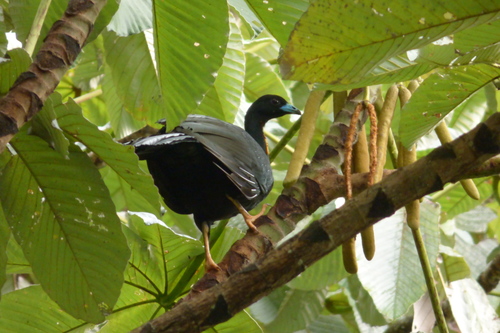
Wattled Guan
Aburria aburri
A majestic specialist of the Andean cloud forests, the Wattled Guan is instantly recognizable by its vibrant red-and-yellow throat wattle and haunting whistles. This elusive bird is a true icon of high-altitude South American biodiversity.
Quick Identification
Size
72–77 cm (28–30 in) in length; weighs approximately 1.2–1.5 kg (2.6–3.3 lbs)
Colors
Uniformly glossy black plumage with a subtle greenish sheen; bill is pale blue at the base and black at the tip; distinctive long, thin wattle is yellow at the base and red toward the tip.
Key Features
- Long, thin, pendulous red-and-yellow throat wattle
- Pale blue bill base with a sharp black tip
- Glossy black plumage without white markings
- Long, broad tail and stocky arboreal build
When You’ll See Them
Geographic range
Where Does the Wattled Guan Live?
The Wattled Guan is a native resident of the South American Andes, occupying a narrow but elongated range that stretches from northern Venezuela through the Colombian and Ecuadorian highlands. It continues south through the eastern slopes of the Andes in Peru, finally reaching its southern limit in the yungas of northern Bolivia. These birds are specialists of the moist, high-altitude 'cloud forest' belt, rarely descending into the true lowlands.
Basemap © OpenStreetMap contributors
Behavior
The Wattled Guan is a primarily arboreal bird, spending the vast majority of its life in the mid-to-upper canopy of humid mountain forests. While they are occasionally seen in pairs or small family groups, they are often solitary and rather shy, making them a prize find for wildlife observers. They are most famous for their dawn displays, where males perform a unique wing-drumming flight through the misty canopy, accompanied by a series of thin, rising whistles that can carry for long distances across the valleys.
Unlike many of their ground-dwelling relatives, Wattled Guans are agile climbers and move through the branches with surprising grace. They are wary of human presence and will often freeze or quietly slip away into denser foliage if they detect movement below. Their social interactions are mostly centered around fruiting trees, where multiple birds may congregate briefly to feed before dispersing back into the shadows of the cloud forest.
EverydayEarth exclusive
Camera Tips
Capturing the Wattled Guan on camera is a rewarding challenge because of their high-altitude, arboreal lifestyle. To see them, focus your camera placement on high ridges or 'saddle' points in the forest where the canopy is slightly lower. If you have access to a balcony or a structure that overlooks the forest mid-story, mount your camera at an eye-level angle with the branches rather than pointing it upward from the ground. This will provide a much clearer view of the distinctive blue beak and wattle.
Timing is everything with this species. They are most active and vocal in the very early morning, often beginning their displays just as the first light hits the canopy. Set your camera's sensitivity high for these low-light conditions. Since they are attracted to specific fruiting trees, such as wild avocados or figs, finding a tree in fruit and aiming your camera at a sturdy horizontal limb nearby is the most effective way to 'bait' them without using artificial food.
Because the Wattled Guan is a large bird, use a camera with a fast trigger speed to capture their wing-drumming displays. If your camera supports video, use it—the sound of their whistling call is just as important for identification and documentation as the visual image. Avoid using heavy flashes at night, as these are diurnal birds and a bright flash in their roosting area may cause them to abandon the site.
Similar Species
Species that look similar or are commonly confused with Wattled Guan.
Frequently Asked Questions
Record Wattled Guan at your habitat
Connect a camera to start building your own species record — AI identifies every visitor automatically.