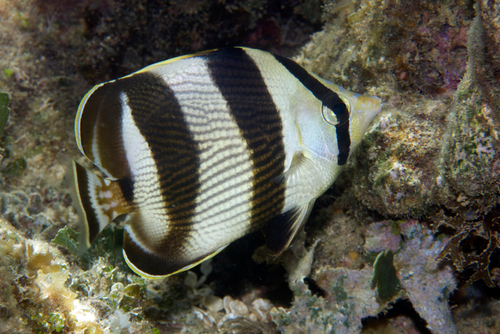
Banded Butterflyfish
Chaetodon striatus
A striking resident of the Western Atlantic, the Banded Butterflyfish is easily recognized by its bold 'zebra' stripes and monogamous lifestyle. Often seen in inseparable pairs, this reef beauty uses a clever 'false eye' to outwit predators.
Quick Identification
Size
12 to 15 cm (4.7 to 6 inches) in length; weighs approximately 100g (3.5 oz)
Colors
Silver-white body with four vertical black bands; the first runs through the eye and the last is at the base of the tail. Fins may have yellow or dusky margins.
Key Features
- Two thick, primary vertical black bands across the body
- Distinct black band running through the eye
- Small black 'false eye' spot on the rear edge of the dorsal fin
- Highly compressed, disk-like body shape
When You’ll See Them
Geographic range
Where Does the Banded Butterflyfish Live?
The Banded Butterflyfish is a native resident of the tropical and subtropical Western Atlantic Ocean. Its range begins in the north along the coasts of Massachusetts and Bermuda, extending south through the Gulf of Mexico and the entire Caribbean basin. They are a frequent sight along the South American coastline, reaching as far south as the warm waters of Brazil.
Basemap © OpenStreetMap contributors
Behavior
The Banded Butterflyfish is a diurnal species, meaning it is most active during the daylight hours when it can be seen gracefully navigating coral reefs and rocky outcrops. These fish are famous for their social structure; they are almost always found in pairs. These pairs are believed to be monogamous and remain together for years, working in tandem to keep a lookout for predators while foraging.
They possess a clever defense strategy involving a 'false eye'—a dark spot located near the tail. This confuses predators into thinking the fish’s tail is its head, often causing the predator to strike in the wrong direction while the butterflyfish darts away. At night, they seek shelter in deep reef crevices, where their colors may darken slightly to help them blend into the shadows and avoid nocturnal hunters.
EverydayEarth exclusive
Camera Tips
Capturing the Banded Butterflyfish on camera requires an underwater setup, such as a GoPro or an AI-powered reef camera in a waterproof housing. Because these fish are creatures of habit, they often follow specific 'patrol' routes around the same coral heads every day. Position your camera at a height of about 12 to 24 inches above the seabed, ideally near a large brain coral or a cluster of tube worms, which are their favorite foraging spots.
Avoid placing the camera in direct shadows; instead, angle it so the sun is behind the lens to illuminate the silver scales and bold black bands. These fish are naturally curious and will often approach a stationary camera to inspect their reflection in the lens, providing excellent close-up opportunities. If you are using a trail camera with an underwater housing, ensure the motion sensor is set to high sensitivity, as their movements can be very fluid and quick.
For the best results, record during the middle of the day when light penetration is at its peak. If your camera settings allow, use a 'red filter' or adjust the white balance to a warmer setting to counteract the blue-green tint of the water. This will ensure that the stark contrast of the black bands against the white body is captured with high fidelity, making for a professional-grade wildlife shot.
Similar Species
Species that look similar or are commonly confused with Banded Butterflyfish.
Frequently Asked Questions
Record Banded Butterflyfish at your habitat
Connect a camera to start building your own species record — AI identifies every visitor automatically.