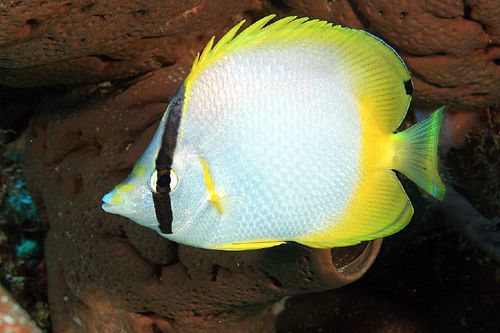
Spotfin Butterflyfish
Chaetodon ocellatus
A masterpiece of Caribbean color, the Spotfin Butterflyfish is easily identified by its sun-yellow fins and its clever 'decoy' eyespot. Often found in inseparable pairs, these reef beauties are a favorite for underwater wildlife watchers.
Quick Identification
Size
15-20 cm (6-8 inches) in length; typically under 0.2 kg (0.5 lbs)
Colors
Brilliant white body, bright yellow dorsal, anal, and pelvic fins, with a black vertical bar through the eye.
Key Features
- Distinct black spot on the rear edge of the dorsal fin
- Vertical black band masking the eye
- Thin, disc-shaped white body
- Yellow fins and tail
- Pointed snout for reef foraging
When You’ll See Them
Geographic range
Where Does the Spotfin Butterflyfish Live?
The Spotfin Butterflyfish is a hallmark of the Western Atlantic Ocean, ranging from the warm coastal waters of North Carolina down through the Gulf of Mexico and the Caribbean Sea to the shores of Brazil. While they are tropical specialists, juveniles are frequently caught in the Gulf Stream and can be found as far north as Massachusetts during the late summer months, though they rarely survive the winter in those northern latitudes. They are most densely populated in the coral-rich waters of the Florida Keys and the Bahamas.
Basemap © OpenStreetMap contributors
Behavior
Spotfin Butterflyfish are highly social and are most famously known for their monogamous pair-bonding. They are almost always seen in pairs, working together to navigate the reef and defend their feeding territory. During the day, they are active and conspicuous, darting between coral heads and rocky outcroppings. They use their specialized snouts to pick small invertebrates and polyps out of tight crevices.
As diurnal creatures, they have a very different routine once the sun sets. At night, they lose their bright coloration, turning a duller gray to blend into the shadows, and seek refuge in deep reef crevices to avoid nocturnal predators like eels and sharks. Their interaction with humans is generally peaceful but shy; while they won't approach a person, they are often comfortable enough around stationary underwater cameras to be filmed in high detail.
EverydayEarth exclusive
Camera Tips
For those with waterfront property or access to a dock, the Spotfin Butterflyfish is a fantastic subject for a submerged 'backyard' camera. To get the best results, mount your camera housing roughly 3 to 6 feet below the low-tide line on a piling that has significant growth of sponges or algae. These fish are naturally attracted to the organisms that grow on artificial structures, making dock pilings an ideal hunting ground for them.
Lighting is your biggest challenge underwater. Try to position the camera lens facing away from the direct sun to avoid 'lens flare' through the water, but ensure the area in front of the lens is well-lit by natural rays. Mid-morning is often the 'golden hour' for underwater photography in shallow water, as the light penetrates deep enough to make the fish's white body pop against the blue-green background without being too harsh.
To encourage a Spotfin to linger in front of your AI camera, you can use a scent-based lure. A small, weighted mesh bag filled with frozen brine shrimp or mysis shrimp attached just out of the frame will create a 'chum' effect that keeps them pecking in the area. Because they are fast and twitchy swimmers, use a fast shutter speed or a high frame rate setting (60fps or higher) to ensure your still captures aren't blurred by their rapid directional changes.
Similar Species
Species that look similar or are commonly confused with Spotfin Butterflyfish.
Frequently Asked Questions
Record Spotfin Butterflyfish at your habitat
Connect a camera to start building your own species record — AI identifies every visitor automatically.