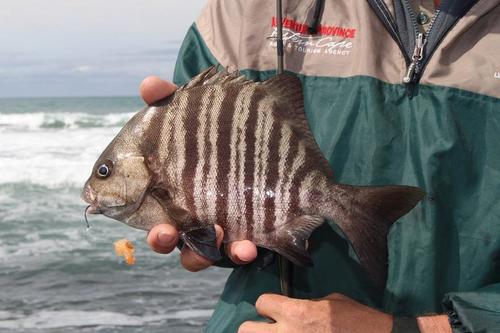
Banded Galjoen
Dichistius multifasciatus
The Banded Galjoen is a striking, striped sentinel of the surf, famous for its ability to navigate the most turbulent rocky coastlines of Southern Africa.
Quick Identification
Size
Typically reaches 25-35 cm (10-14 inches) in length and weighs up to 1.7 kg (3.7 lbs).
Colors
Dark brown to blackish body featuring 15 to 20 distinct vertical brown-black stripes; the belly is generally lighter or silvery-grey.
Key Features
- 15-20 dark vertical bands along the body
- Compressed, oval-shaped body profile
- Small mouth with thick, fleshy lips
- Found primarily in high-energy surf zones
- Maximum length of approximately 35 cm
When You’ll See Them
Geographic range
Where Does the Banded Galjoen Live?
The Banded Galjoen is a coastal specialist native to the southern and eastern shores of Africa. Its primary range spans the warm-temperate and subtropical waters of South Africa, moving from the southern Cape coast up through KwaZulu-Natal. Beyond the mainland, thriving populations are also found in the coastal reef systems surrounding Madagascar and occasionally as far north as Mozambique.
Basemap © OpenStreetMap contributors
Behavior
These fish are highly territorial and show a strong preference for specific rocky gullies. They are known for their agility, navigating through narrow crevices and powerful surges that would overwhelm less powerful swimmers. While they are a prized catch for shore-based anglers, they are relatively wary of large movements, making them a challenge to spot without a dedicated underwater setup.
EverydayEarth exclusive
Camera Tips
Stability is your biggest challenge in the habitat of the Banded Galjoen. Use a weighted tripod or a dedicated 'rock mount' to prevent the camera from being tossed by the waves. If you are using an AI-powered camera, ensure the housing is clear of salt-spray and bubbles, as the 'white water' can often trigger false motions or obscure the fish's distinct stripes. A side-on angle is best to capture the full profile of the bands, which are their most identifying feature.
Timing is everything when filming coastal fish. The best results usually occur during a rising tide when the fish move into the shallower gullies to feed. Mid-day light is preferred as it penetrates deeper into the water, helping the camera’s sensor pick up the dark stripes against the rocky background. While not traditionally 'baited' like land animals, placing a crushed mussel or sea urchin in front of the lens can attract the Banded Galjoen and keep it in the frame for a longer duration.
Similar Species
Species that look similar or are commonly confused with Banded Galjoen.
Frequently Asked Questions
Record Banded Galjoen at your habitat
Connect a camera to start building your own species record — AI identifies every visitor automatically.