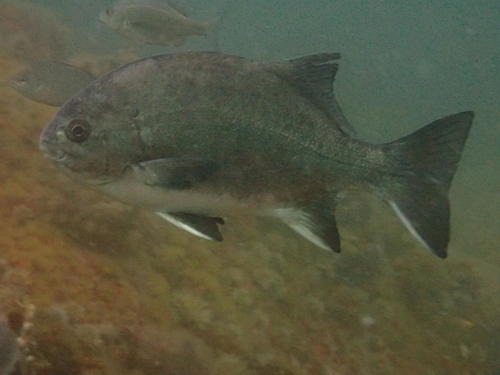
Galjoen
Dichistius capensis
South Africa's national fish is a master of the crashing surf. With the ability to change its color to match the rocks, the Galjoen is a resilient icon of the southern African coastline.
Quick Identification
Size
Typically 35-50 cm (14-20 in), reaching up to 80 cm (31 in); weight up to 6.5 kg (14 lbs)
Colors
Variable from silver-grey to almost black; features 7-9 dark vertical bars that can fade depending on the environment
Key Features
- Oval-shaped, compressed body
- Thick, leathery skin with small scales
- Powerful, broad tail fin
- Small mouth with strong, curved teeth for crushing shells
When You’ll See Them
Geographic range
Where Does the Galjoen Live?
Native to the southern African coastline, the Galjoen is a true regional specialist. Its core range spans from northern Namibia down the Atlantic coast to the Cape of Good Hope, and then eastward along the Indian Ocean coast of South Africa into KwaZulu-Natal. While occasionally spotted as far north as southern Angola, it remains a quintessential inhabitant of the cold to temperate waters of the Benguela and Agulhas ecosystems.
Basemap © OpenStreetMap contributors
Behavior
The Galjoen is a legendary resident of the 'white water'—the turbulent, oxygen-rich surf zone where waves break against rocky shores. They are exceptionally strong swimmers, evolved to navigate high-energy environments where other fish would be tossed against the rocks. They are known for their remarkable ability to change color almost instantly, shifting from light silver to deep charcoal to blend in with their immediate surroundings, whether it be sandy patches or dark reef crevices.
While they are generally solitary when foraging, they can congregate in small groups in areas where food is abundant. They exhibit high site fidelity, meaning they often stay within a very small area of the coast for their entire lives. To humans, they are known as a challenging and respected species, having earned the title of South Africa's national fish due to their resilience and presence across the country's diverse coastline.
EverydayEarth exclusive
Camera Tips
Capturing the Galjoen requires specialized equipment as they live in some of the most violent water on earth. If you have a coastal 'backyard,' use a waterproof action camera with an AI-triggering system housed in a weighted cage. Place the camera in large, permanent rock pools during high tide or securely tether it to a rocky ledge in the shallow subtidal zone where waves are actively breaking.
Lighting is your biggest challenge in the surf. Aim for mid-morning or mid-afternoon when the sun is at an angle to reduce the glare from the white foam on the surface. Set your camera to a high frame rate (at least 60fps) because the movement of both the water and the fish is incredibly rapid in the surge.
To attract a Galjoen to your lens, focus on areas with heavy mussel or barnacle growth. You can gently crush a few local mussels near the camera site to release a scent trail. Because these fish are shy, leave the camera unattended for several hours; the AI-powered motion detection will do the work of filtering out the movement of seaweed and bubbles to find the silver flash of a passing Galjoen.
Similar Species
Species that look similar or are commonly confused with Galjoen.
Frequently Asked Questions
Record Galjoen at your habitat
Connect a camera to start building your own species record — AI identifies every visitor automatically.